

Most enterprise IT leaders have sat through at least one presentation where event-driven architecture was described as the solution to all integration problems. The diagrams look elegant. The value proposition sounds compelling. And then reality sets in.
The truth is, event-driven architectures can genuinely transform how large organisations operate, but only if you understand what you’re actually signing up for. This isn’t about technology trends. It’s about whether your organisation is prepared to handle the operational, governance, and cultural shifts that come with fundamentally changing how your systems talk to each other.
Why Event-Driven Architecture Matters Now
Traditional point-to-point integrations worked when enterprises had 15 systems. They start breaking down when you have 150. For most mid-to-large Indian enterprises today, the challenge isn’t whether to modernise, it’s how to do it without disrupting operations that generate hundreds or thousands of crores in revenue every quarter.
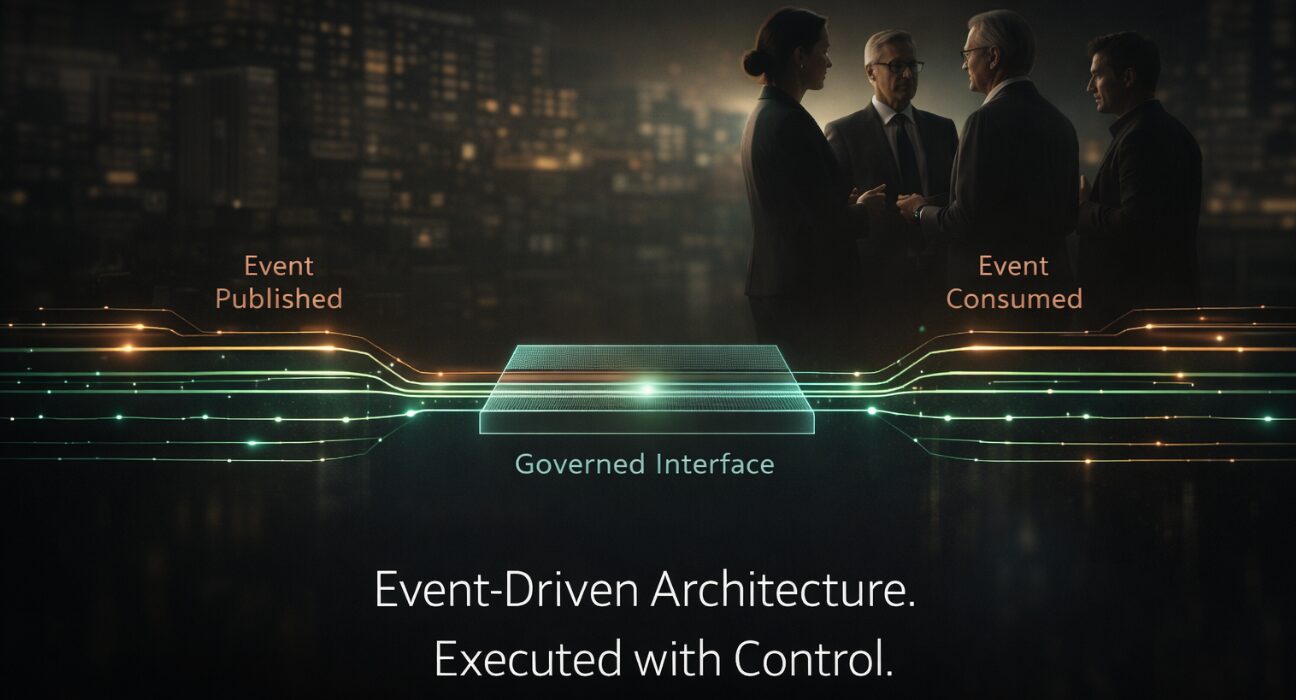
Event-driven architecture promises something simple: systems react to things that happen, rather than constantly asking each other for updates. A customer places an order, and that event automatically triggers inventory updates, payment processing, logistics coordination, and CRM updates. No one system needs to know about all the others. They just need to know what happened.
This sounds straightforward until you’re six months into implementation and realise that “what happened” means different things to different departments, your legacy ERP doesn’t publish events at all, and three vendors are blaming each other for why the finance system hasn’t received a single transaction yet.
The Real Challenges Nobody Warns You About
The Legacy System Problem
Every large enterprise has core systems that are 10, 15, or 20 years old. They were built when integration meant FTP file transfers or direct database connections. These systems don’t speak the language of events. They weren’t designed to.
You have three choices: replace them, wrap them, or work around them. Replacing them is expensive and risky. Wrapping them with adapters adds complexity and potential points of failure. Working around them means your event-driven architecture isn’t actually enterprise-wide; it’s more like a modern island surrounded by the old world.
Most enterprises end up doing all three in different places, which means your architecture is already more complicated than any diagram suggested.
The Governance Nightmare
When 40 different applications are publishing events, and 60 are consuming them, who decides what an “OrderPlaced” event should contain? What happens when the sales team wants to add customer sentiment data to order events, but the finance team says that’s irrelevant noise?
Somebody needs to own the event schema. Somebody needs to version it. Somebody needs to decide when breaking changes are acceptable. And somebody needs to enforce these decisions across teams that have different priorities, different deadlines, and different vendors.
This isn’t a technology problem. It’s an organisational one. The companies that succeed with event-driven architectures don’t necessarily have the best technology; they have the clearest governance and the strongest executive ownership.
The Operational Complexity
Your traditional integration setup might have had 200 point-to-point connections. Complicated, yes, but at least you could trace a problem. System A calls System B. If something breaks, you know where to look.
With event-driven architecture, System A publishes an event. Twelve systems consume it. Three of them transform it and publish new events. Seven more systems consume those. When something goes wrong, finding the root cause means tracing through potentially dozens of systems and hundreds of event flows.
Your operations team needs new skills. Your monitoring tools need complete rethinking. Your incident management process needs to account for cascade failures that weren’t possible before. And your disaster recovery strategy needs to handle event streams that might be processing millions of messages per hour.
What Actually Makes These Programs Succeed
After seeing enough enterprise transformation programs, both successful and failed, some patterns become clear.
Executive Sponsorship That Goes Beyond Approval
Every major program has executive sponsorship. But there’s a difference between an executive who approved the budget and one who actively removes obstacles, makes tough calls on competing priorities, and holds teams accountable for delivery.
Event-driven architecture programs require executives who understand they’re not just buying technology, they’re changing how the organisation works. When the sales system and the finance system have fundamentally different views on what constitutes a “completed sale,” that’s not an IT problem to solve. That’s a business process problem that needs executive-level resolution.
Realistic Timelines
A true enterprise-wide event-driven architecture isn’t implemented in six months. It’s not even implemented in a year. For most large organisations, this is a three-to-five-year journey with distinct phases and measurable milestones.
The organisations that succeed start with one domain, maybe order management or customer data, prove the model works, learn from the mistakes, and then expand. The ones that fail often try to do everything at once because someone sold them on a “big bang” transformation.
The Right Partner Model
Most enterprises don’t have unlimited internal capacity. You’re going to work with partners. The question is what kind of partners you choose.
Some partners are excellent at architecture and design. They’ll give you beautiful blueprints. But when it comes to the messy reality of actually implementing this across your organisation, handling vendor conflicts, dealing with legacy system limitations, managing stakeholder expectations, training your teams, they’re less interested.
This is where organisations like Ozrit make a difference. The value isn’t just in designing the architecture, it’s in having a partner who understands enterprise program delivery, who’s managed complex stakeholder environments before, and who knows that most program failures happen not because of technology choices but because of execution gaps.
Vendor Management
Your event-driven architecture will likely involve multiple technology vendors. You’ll have a message broker provider, maybe a streaming platform, API management tools, and monitoring solutions. Each vendor will tell you their product is the foundation on which everything else should be built.
Managing these vendors, ensuring they work together, holding them accountable for integration issues, preventing finger-pointing when things break, requires someone who understands the full technical landscape and has the authority to make vendors cooperate. This rarely happens by accident.
The Financial Reality
Let’s talk about money, because that’s what CFOs care about and what sinks many programs.
Your initial budget probably covers licenses, implementation services, and some infrastructure. What it often doesn’t account for:
The operational costs of running a much more complex infrastructure. The tools you need to monitor and manage event flows. The additional headcount or training required for your operations team. The cost of maintaining adapters for legacy systems. The inevitable architecture changes as you learn what actually works in your environment.
A realistic enterprise event-driven architecture program for a mid-to-large organisation should expect total investment running into several crores over three to five years. This includes technology costs, but also the business cost of the organisational change required to make this work.
The organisations that succeed in budgeting realistically from the start. The ones that struggle often discover these costs midway through, leading to either scope reduction or asking for more funding, both of which damage program credibility.
Getting the Strategy Right
Before you commit to enterprise-wide event-driven architecture, answer these questions honestly:
Do you have a clear business case? “Modern architecture” isn’t a business case. Reducing integration costs by 40% over three years is. Enabling new digital channels that generate Rs 50 crore in additional revenue is. If you can’t articulate the business value in terms your CFO cares about, you’re not ready.
Can you start small and prove value? Identify one business domain where event-driven architecture solves a real problem today. Implement it properly. Measure the results. Learn from the challenges. Then expand. This approach might feel slower, but it’s actually faster than a big-bang implementation that stalls midway.
Do you have the governance model? Who owns the event schemas? Who makes decisions when teams disagree? Who has the authority to enforce standards? If you don’t have clear answers, you’ll spend months arguing about technical details while making no progress.
Is your organisation ready for the operational shift? Your operations team will need different skills. Your incident management will need different processes. Your vendors will need different support models. Have you planned for this, or are you assuming it will just work out?
What Modern Execution Actually Looks Like
The enterprises that deliver successful transformation programs don’t just have a good technology strategy. They have mature execution practices.
This means proper program management, not just status meetings, but active risk management, dependency tracking, and decision-making frameworks. It means technical governance that balances standardisation with pragmatism. It means vendor management that holds everyone accountable while enabling collaboration.
It also means honest conversations about what’s working and what isn’t. Too many enterprise programs operate in an environment where nobody wants to be the one to say things are off track. By the time problems become obvious, they’ve compounded to the point where recovery is difficult.
Partners who have delivered large-scale enterprise programs understand this. Whether you’re working with Ozrit or another execution-focused partner, the value is in having someone who’s seen these challenges before, knows how to navigate them, and isn’t afraid to have difficult conversations early when they can still make a difference.
Making It Work in the Indian Context
Indian enterprises face some unique challenges. Many are dealing with systems built by multiple vendors over many years, with varying levels of documentation and support. Decision-making often involves more stakeholders than Western enterprises, requiring careful consensus-building. And cost pressure is usually higher, meaning less room for expensive mistakes.
At the same time, Indian enterprises often have advantages. Teams are used to working with complex, imperfect systems and finding practical solutions. There’s often more flexibility in terms of gradual evolution rather than wholesale replacement. And the talent pool for both technology and program management is strong.
The key is acknowledging these realities in your strategy. A transformation approach that works for a European or American enterprise might need significant adaptation for the Indian context. This isn’t about lowering standards; it’s about being realistic about the environment you’re operating in.
The Long View
Event-driven architecture isn’t a project with a defined end date. It’s a capability you build over time. The organisations that succeed recognise this and plan accordingly.
They don’t expect everything to work perfectly from day one. They built in time for learning and adjustment. They celebrate progress even when it’s incremental. They maintain executive focus even when the program isn’t generating headlines.
Most importantly, they understand that technology is only part of the story. The real transformation is in how the organisation operates, how teams collaborate, how decisions get made, and how problems get resolved. Get that right, and the technology will follow. Get it wrong, and no amount of sophisticated architecture will save you.
Moving Forward
If you’re a CIO, CTO, or CDO considering event-driven architecture for your enterprise, the question isn’t whether it’s the right technical choice. In most cases, it probably is. The question is whether your organisation is ready for what it takes to implement it successfully.
That requires honest assessment of your current capabilities, realistic planning of what the journey looks like, strong governance of how decisions will be made, and the right partners to help navigate the challenges that every enterprise transformation faces.
The good news is that this is entirely achievable. Enterprises across India and globally are successfully implementing event-driven architectures and seeing real business value. But they’re doing it with clear eyes about the complexity involved and proper investment in execution, not just technology.
The choice isn’t between perfection and failure. It’s between moving forward thoughtfully, with proper planning and support, or rushing ahead and discovering the hard way why enterprise transformation is called transformation, because it changes everything, not just your technology stack.