
How Food App Development Is Transforming the Restaurant and Delivery Industry
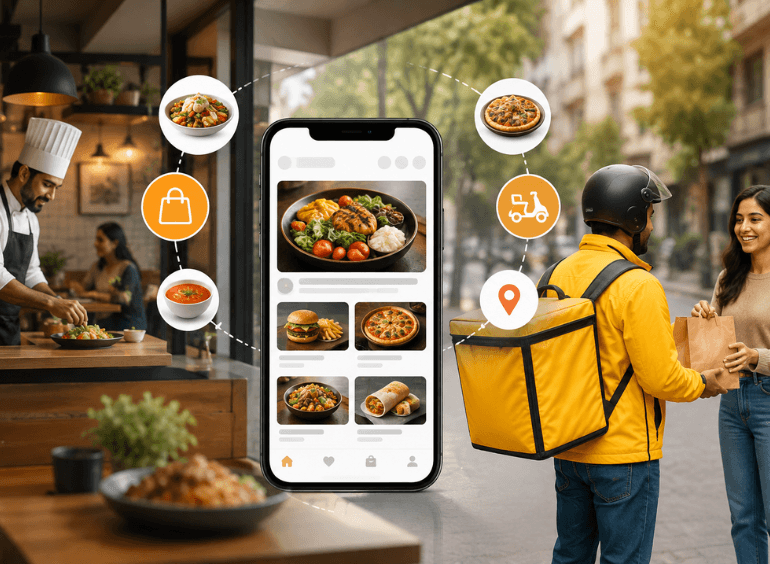
There was a time when ordering food meant picking up the phone, explaining your order and hoping the person on the other end heard everything correctly. Today, a customer in Hyderabad can search for biryani, compare restaurants, check ratings, place an order, pay digitally and track the delivery without making a single call.
The change is not limited to food delivery. Mobile apps are influencing how people discover restaurants, reserve tables, interact with menus, collect rewards and decide what to eat next.
For restaurants and food businesses, this shift has created new opportunities, but it has also raised customer expectations. People want accurate menus, reasonable prices, reliable delivery and increasingly, an experience that feels tailored to them.
Food apps are becoming the link between what restaurants offer and how modern Indian customers actually eat.
From Phone Calls to a Few Taps
Food ordering has become remarkably convenient.
A working professional in Bengaluru can order breakfast before leaving home. Someone in Mumbai can place a late-night meal order without worrying about whether the restaurant is still taking phone calls. In Hyderabad, biryani can be ordered from a favourite restaurant while sitting at home, at work or even during a family gathering.
This convenience has changed customer behaviour.
People can browse several restaurants before deciding. They can look at photographs, menus and reviews, compare prices and see estimated delivery times.
For restaurants, this means being discoverable is almost as important as being good.
A customer may never walk past a particular restaurant physically, but an app can put it in front of them at exactly the right moment.
Digital Menus Have Changed How Customers Choose
Paper menus still have their place, particularly in traditional restaurants. But digital menus offer considerably more flexibility.
Restaurants can update prices, add seasonal dishes, highlight popular items and remove unavailable products without printing new menus.
A digital menu can also provide photographs, ingredient information, portion details and customisation options.
For customers, this makes choosing easier.
Someone ordering South Indian breakfast in Bengaluru might want to compare idli, vada, dosa and pongal before deciding. A customer looking for Andhra food in Hyderabad may want to know how spicy a particular dish is.
The more useful the information, the less uncertainty there is at the time of ordering.
Personalised Recommendations Can Influence What We Eat
Food choices are often influenced by mood, habit and convenience.
A customer who regularly orders vegetarian meals may prefer seeing relevant options first. Someone who frequently orders desserts may be interested in new additions from restaurants they already like.
Mobile apps can use previous orders, browsing behaviour, location and preferences to provide personalised recommendations.
AI can take this further by identifying patterns across large amounts of customer activity.
But personalisation has to be handled carefully. Nobody wants an app that keeps pushing the same dish simply because they ordered it once.
Good recommendations should feel helpful, not intrusive.
Discounts Still Matter to Indian Customers
Let’s be honest: price plays a major role in food ordering decisions.
Indian consumers are often willing to try a new restaurant when there is a compelling discount, combo offer or free-delivery deal. At the same time, customers have become more aware of the final bill and may compare prices before placing an order.
Restaurants therefore have to think carefully about promotions.
Constant discounting may bring orders but can make it difficult to build long-term profitability. A better approach can be to use customer data to understand when offers are actually useful.
For example, a restaurant could provide a relevant reward to a regular customer rather than offering the same discount to everyone.
The old saying “value for money” still carries plenty of weight.
Digital Payments Make Checkout Easier
The widespread adoption of UPI has made digital food payments almost effortless.
Customers can pay for an order without handling cash, while restaurants receive digital confirmation and can maintain better transaction records.
A well-designed food app can offer multiple payment options and make the checkout process straightforward.
This matters because customers do not want to spend several minutes filling in information after they have already decided what they want.
The easier the checkout, the less likely customers are to abandon the order.
Delivery Tracking Has Become Part of the Experience
Waiting for food can feel much longer when there is no information about the order.
Food apps have changed this by providing status updates such as order confirmed, food being prepared, picked up and out for delivery.
For a customer waiting for dinner in Chennai, knowing that the delivery partner has collected the order can provide reassurance.
For restaurants, tracking can also help identify delays.
If an order has been waiting for pickup for an unusually long time, staff can investigate rather than assuming everything is fine.
Visibility benefits both sides.
Restaurants Are Using Apps to Improve Operations
The customer sees the ordering screen, but the restaurant sees an entirely different side of the system.
Incoming orders need to reach the kitchen quickly. Staff need to know what is being prepared. Orders must be packed correctly and handed to the right delivery partner.
A connected system can reduce manual coordination between the front desk, kitchen and delivery team.
For busy restaurants, especially during lunch and dinner rushes, this can make a real difference.
A restaurant in Bengaluru handling a large number of breakfast orders may need to coordinate preparation and pickup within a narrow time window. Better digital workflows can help reduce confusion during those busy periods.
Cloud Kitchens Have Benefited From the App Economy
Cloud kitchens have grown alongside app-based food ordering.
Because these businesses do not necessarily depend on traditional dine-in spaces, they can focus heavily on takeaway and delivery. Some operate multiple food concepts from a single kitchen, targeting different customer preferences.
Apps give cloud kitchens access to customers without requiring a prominent physical location.
This has lowered some barriers to entering the food business, but competition has become intense as well.
Customers can easily compare dozens of options. A cloud kitchen therefore needs more than an attractive menu. Food quality, consistency, packaging, pricing and delivery performance all matter.
A digital presence may bring the first order, but the food has to bring the customer back.
Loyalty Programmes Can Encourage Repeat Orders
Restaurants have long tried to encourage repeat business.
Mobile apps make loyalty programmes easier to manage.
Customers can earn points, receive rewards, access special menus or get personalised offers based on their order history.
A regular customer who orders biryani twice a month, for instance, may respond better to a relevant reward than to a generic promotional message every day.
Loyalty also gives restaurants an opportunity to understand customer behaviour.
The objective should be to reward genuine loyalty rather than simply encourage customers to wait for discounts.
Table Reservations Are Also Going Digital
Food apps are not limited to delivery.
Customers increasingly use digital platforms to discover restaurants, check availability and make table reservations.
This is particularly useful for popular restaurants during weekends, festive periods and special occasions.
A customer planning a family dinner in Mumbai can check restaurant details and reserve a table before leaving home.
For restaurants, digital reservations can make seating management more organised and provide useful information about expected demand.
The dining experience starts before the customer reaches the restaurant.
Customer Reviews Influence Restaurant Discovery
Reviews have become an important part of restaurant selection.
Before trying an unfamiliar place, customers often check ratings, photographs and comments from other diners.
This has changed the relationship between restaurants and customers.
A poor experience can become visible to many potential customers, while consistently good food and service can help a relatively unknown restaurant gain attention.
Restaurants therefore need to treat feedback as more than a marketing issue.
Reviews can reveal recurring problems with packaging, portion sizes, food temperature, delivery delays or service.
Not every review will be fair, but patterns in feedback are worth paying attention to.
Food App Development Connects the Experience
This is where Food App Development fits into the larger transformation of the industry.
The challenge is not simply to create a screen where customers can select dishes. A useful food application may need to connect menus, restaurant operations, customer accounts, payments, delivery tracking, reservations, loyalty programmes and analytics.
For example, a customer places an order through the app. The restaurant receives it, the kitchen updates its preparation status, a delivery partner collects it, tracking information reaches the customer and the payment is recorded.
Each step depends on information moving smoothly between different participants.
When the systems work together, the customer sees a simple experience even though the operation behind it may be quite complex.
Delivery Partners Are Also Part of the Digital Ecosystem
Food delivery partners operate under significant time pressure.
They need accurate pickup locations, customer addresses, navigation and order information. They also need to communicate when problems occur.
Mobile applications can help delivery partners manage these tasks from the road.
If a restaurant is running late with an order, the delivery partner can receive an update rather than waiting without information. If the customer is unavailable, the situation can be reported quickly.
The technology needs to account for real-world conditions, though.
Poor network connectivity, battery limitations, difficult addresses and traffic can all affect the experience.
A food app may be digital, but the final delivery still happens in the physical world.
Subscription-Based Food Services Are Growing
Another development worth watching is the growth of subscription-based food services.
Customers may subscribe to meal plans, office lunches, healthy meals or regular grocery-and-food deliveries.
This model can be attractive for people who value predictability.
A working professional in Hyderabad, for example, may prefer a monthly meal plan rather than deciding what to order every afternoon.
For food businesses, subscriptions can provide more predictable demand and help with planning ingredients and kitchen capacity.
But consistency becomes critical. Customers paying regularly expect the service to remain reliable.
Data Can Help Restaurants Understand Demand
Restaurants generate useful information every day.
They can see which dishes sell during lunch, which items perform better on weekends, when orders peak and which products are frequently added to carts but not purchased.
This data can influence menu planning and inventory decisions.
Suppose a restaurant notices that one dish sells heavily during weekday lunches but barely moves at night. It may adjust preparation quantities accordingly.
Similarly, if a particular area generates many orders but has frequent delivery delays, the restaurant may need to reconsider delivery scheduling or operational arrangements.
The goal is not to collect data for its own sake.
The real benefit is understanding customer behaviour well enough to make better decisions.
Food Apps Also Bring Challenges
The digital food economy is not without problems.
Restaurants have to manage commissions, discounts, packaging costs, delivery charges and customer expectations. High order volumes can put pressure on kitchens during peak periods.
Customers may face inconsistent delivery times, changing prices or limited availability.
Delivery partners deal with traffic, weather and tight schedules.
There are also concerns around customer data and privacy. Restaurants and food platforms need to handle personal and payment information responsibly.
Technology can improve the food experience, but it cannot compensate for poor food quality, weak operations or unrealistic delivery promises.
What Restaurants Should Focus On
Restaurants do not need to adopt every technology simply because it is trending.
The basics still matter.
Keep menus accurate. An unavailable dish should not remain orderable.
Make ordering simple. Customers should be able to find what they want quickly.
Provide realistic delivery estimates. It is better to be accurate than overly ambitious.
Use customer data responsibly. Personalisation should improve relevance without becoming intrusive.
Make payments easy. Support familiar digital payment methods.
Pay attention to reviews. Look for recurring issues rather than reacting emotionally to individual comments.
Measure profitability. More orders do not automatically mean a healthier business.
The Future of Food Ordering in India
The food industry is moving towards a more personalised and connected experience.
AI can help with recommendations and demand forecasting. Digital menus can become more interactive. Restaurant systems can become better integrated with kitchens and delivery operations. Subscription models can provide more predictable ordering patterns.
At the same time, Indian food habits will continue to shape the technology.
People may order dosa for breakfast in Bengaluru, biryani in Hyderabad, seafood in Chennai or a late-night meal in Mumbai. Regional preferences, family occasions, festivals and local pricing will continue to influence what customers choose.
That is why there is no single formula for the Indian food market.
Technology needs to adapt to customers rather than expecting customers to adapt to technology.
More Than Just a Food-Ordering App
The biggest change brought by mobile food applications is that they have connected different parts of the restaurant ecosystem.
Customers can discover restaurants and order meals. Kitchens can receive and manage orders digitally. Delivery partners can navigate and communicate more efficiently. Restaurants can understand customer preferences and demand patterns. Loyalty programmes can encourage repeat visits, while digital payments make transactions easier.
The food itself remains the heart of the business. No app can change that.
But the way customers discover, order, pay for and experience food is changing rapidly.
From a biryani order in Hyderabad to a breakfast delivery in Bengaluru or a late-night meal in Mumbai, mobile apps are becoming part of everyday food culture.
And as Indian consumers continue to value convenience, choice and value for money, the restaurant and delivery industry will increasingly depend on how well it combines good food with a genuinely convenient digital experience.