
How Logistics App Development Is Helping Indian Businesses Simplify Delivery Operations
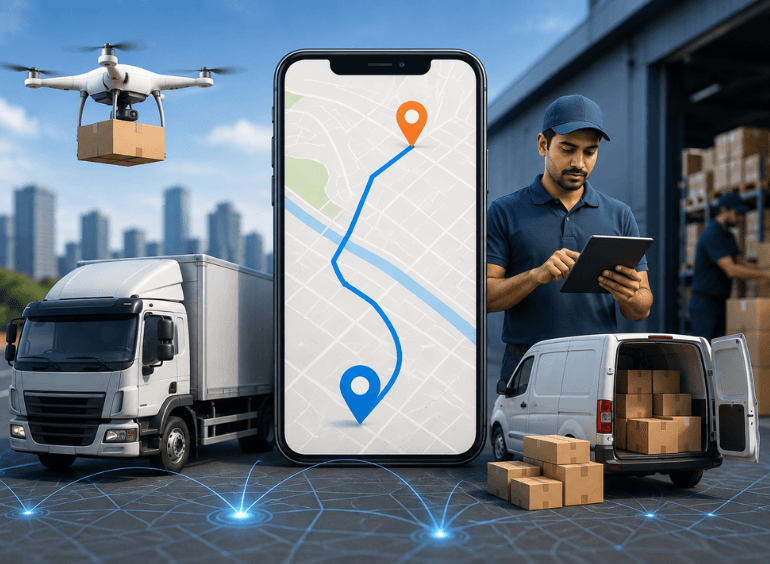
A delivery may look simple from the customer’s point of view. You place an order, receive a notification and wait for the package to arrive. Behind the scenes, however, there could be a warehouse team preparing the shipment, a fleet manager assigning a vehicle, a driver navigating traffic and an operations team keeping track of dozens of deliveries at the same time.
In India, that process can get complicated very quickly.
A delivery vehicle travelling across Hyderabad may face unexpected traffic around Hitech City. A driver in Bengaluru might spend valuable time navigating congested roads. In Mumbai, dense neighbourhoods and parking restrictions can make the final few kilometres surprisingly difficult. Add fuel costs, changing customer expectations and thousands of daily shipments, and managing deliveries manually becomes a tough balancing act.
This is where logistics apps are becoming increasingly useful. They bring different parts of the delivery operation into one connected system, giving businesses better visibility and helping teams make quicker decisions.
India’s Delivery Landscape Is Changing
Indian consumers have become accustomed to convenience.
Quick-commerce platforms have made short delivery windows familiar. E-commerce has made shipment tracking almost routine. UPI has made digital payments easy, while online marketplaces have increased expectations around delivery choices and communication.
Customers now want to know more than whether an order has been dispatched.
They may want to know:
- Where is the shipment right now?
- When will it arrive?
- Can I change the delivery time?
- Can I pay digitally?
- What happens if I miss the delivery?
- Can I return or exchange the product easily?
For businesses, meeting these expectations requires coordination across multiple teams.
A logistics app can provide the digital infrastructure needed to manage that coordination.
GPS Tracking Gives Businesses a Clearer Picture
One of the biggest advantages of a logistics app is real-time location tracking.
Fleet managers can see where vehicles and delivery executives are, monitor active trips and identify delays. Instead of calling drivers repeatedly to ask for updates, managers can access much of the information directly through the system.
Imagine a company handling deliveries across Hyderabad. If several vehicles are delayed because of traffic, the operations team can see the situation and adjust delivery schedules accordingly.
The information can also be used after deliveries are completed. Businesses can analyse routes and identify areas where vehicles regularly spend too much time.
GPS tracking, therefore, is not only about knowing where a vehicle is. It can help businesses understand how their delivery network actually behaves.
Smarter Route Planning Saves Time and Fuel
Indian roads can make route planning challenging.
The shortest route is not always the fastest. Traffic congestion, road closures, construction, delivery time windows and local restrictions can all affect the journey.
Route optimisation tools can consider multiple factors and suggest a more practical sequence of stops.
For example, a driver making deliveries across Bengaluru may have ten orders spread across Whitefield, Koramangala and Indiranagar. A sensible delivery sequence can reduce unnecessary travel and help the driver complete more stops during the day.
This matters because fuel is a significant operating cost.
Even a small reduction in kilometres per vehicle can become meaningful when a business manages dozens or hundreds of vehicles.
Last-Mile Delivery Is Where Problems Often Surface
Getting goods from a warehouse to a city is one challenge. Getting them from the local hub to the customer’s doorstep is another.
The last mile often involves difficult addresses, apartment complexes, traffic, parking problems and customers who may not be available when the driver arrives.
A logistics app can give drivers access to customer instructions, navigation, contact information and delivery details in one place.
A customer in Chennai, for instance, may be able to provide a landmark or specific delivery instruction before the driver arrives. That small piece of information can save several minutes of searching.
Across thousands of deliveries, those minutes add up.
Real-Time Tracking Keeps Customers Informed
Customers are far more comfortable with deliveries when they know what is happening.
A logistics app can automatically trigger updates when an order is dispatched, reaches a distribution centre, goes out for delivery or is successfully delivered.
Businesses can also provide estimated arrival times where the underlying data supports it.
This reduces uncertainty and can lower the number of customer support calls asking for delivery status.
More importantly, transparency builds trust.
If a delivery is delayed because of traffic or another operational issue, informing the customer is generally better than leaving them guessing.
Digital Proof of Delivery Makes Records Easier to Manage
Paper-based delivery records can create unnecessary administrative work.
Drivers may have to collect signatures, maintain documents and submit them later. If a customer disputes a delivery, the business then has to locate the relevant paperwork.
Mobile apps can digitise this process.
Depending on the business, proof of delivery can include a digital signature, photograph, OTP verification or another form of confirmation.
The information can be linked directly to the order, creating a clearer record of what happened.
For businesses handling a large number of deliveries, this can make dispute resolution and record-keeping much easier.
Drivers Get a Better View of Their Daily Work
Delivery drivers are at the heart of the operation.
A good logistics app can show them the day’s assignments, delivery sequence, customer details, navigation and required delivery confirmations.
It can also allow them to report problems.
A customer may not answer the phone. A vehicle may develop a problem. A delivery address may be incorrect. Instead of relying entirely on calls and paper notes, the driver can update the situation through the app.
This gives operations teams a more immediate picture of what is happening on the ground.
The important point is that technology should make the driver’s job easier. If an app requires too many steps for a simple delivery update, it defeats the purpose.
Warehouse Coordination Is Part of the Delivery Equation
Delivery efficiency starts before the vehicle leaves the warehouse.
Orders need to be picked, packed, labelled and assigned correctly. If the warehouse is running behind schedule, vehicles may sit idle while drivers wait.
A connected logistics application can help warehouse teams update order status, scan packages and identify shipments that are ready for dispatch.
When this information is available to fleet and operations teams, vehicle allocation can be better coordinated.
For a busy distribution centre, even a modest improvement in loading and dispatch times can have a noticeable effect on daily operations.
Inventory Visibility Prevents Unnecessary Delays
A customer placing an order expects the product to be available.
If inventory information is inaccurate, the business may promise a delivery that it cannot fulfil. This can result in cancellations, delays and unhappy customers.
Logistics apps connected to inventory systems can provide better visibility into where stock is located and how it is moving.
A business with warehouses in Hyderabad, Bengaluru and Chennai, for example, can use this information to understand stock availability across locations and plan transfers or replenishment more effectively.
It also gives managers a better understanding of how products move through the supply chain.
Payments Can Be Integrated Into Delivery Workflows
For businesses that support cash-on-delivery or collect payments during delivery, mobile apps can simplify payment management.
Delivery partners can record payment status, confirm digital transactions and update collection information immediately.
With UPI already a familiar part of everyday transactions in India, digital payment workflows can be integrated naturally into many delivery operations.
The result is better visibility for the business and fewer manual records to reconcile later.
Automated Notifications Reduce Unnecessary Calls
Logistics involves constant communication.
Warehouse teams need dispatch updates. Drivers need route changes. Customers want delivery notifications. Managers need to know about failed deliveries and exceptions.
Automated notifications can handle many routine messages.
A customer can receive an alert when the order is out for delivery. A driver can receive an updated instruction. An operations manager can be alerted when a shipment crosses a defined delay threshold.
Automation does not mean removing people from the process. It simply takes care of predictable updates, leaving teams free to focus on situations that actually require human attention.
Data Turns Delivery Problems Into Business Insights
Perhaps one of the most valuable advantages of a logistics app is the data it generates.
Businesses can analyse:
- Average delivery times
- Vehicle utilisation
- Fuel consumption
- Failed deliveries
- Frequently delayed routes
- Driver workloads
- Customer delivery patterns
- Warehouse processing times
This information can reveal problems that are difficult to identify through day-to-day operations.
Suppose a company discovers that deliveries to a particular area of Mumbai are regularly delayed between 6 PM and 8 PM. It could adjust delivery slots, change route planning or allocate additional resources during those hours.
Instead of saying, “This route always causes trouble,” managers have data that can help explain why.
Where Logistics App Development Fits In
Logistics app development is increasingly focused on connecting these different activities rather than simply creating an app for delivery drivers.
A modern logistics operation may involve fleet managers, drivers, warehouse teams, business administrators, delivery partners and customers. Each group needs different information, but their activities are closely connected.
For example, a warehouse marks an order as dispatched. The fleet team assigns a vehicle. The driver receives the delivery details. GPS tracking updates the trip status. The customer receives a notification. Once the package arrives, digital proof of delivery closes the order.
When these steps are connected, information does not have to be entered repeatedly or passed from one person to another through phone calls.
That is where the real operational benefit comes from.
How Indian Businesses Can Start Simplifying Delivery
Businesses do not need to digitise every process overnight.
A better approach is to identify the areas creating the most problems.
If fleet visibility is poor, begin with GPS tracking.
If fuel costs are rising, analyse routes and vehicle utilisation.
If customers are frequently asking where their orders are, improve tracking and notifications.
If delivery disputes are common, introduce digital proof of delivery.
If warehouses and transport teams are not coordinated, connect dispatch information with vehicle allocation.
The technology should follow the business problem, not the other way around.
Faster Does Not Always Mean Better
There is considerable pressure on logistics businesses to deliver faster. Quick commerce has reinforced this expectation, but speed should not come at the expense of reliability.
A customer may prefer a delivery that arrives in two hours as promised over one advertised as 30 minutes that arrives much later.
Businesses therefore need to balance speed with realistic capacity.
Better route planning, accurate inventory information, efficient warehouse coordination and reliable communication can often improve delivery performance without simply asking drivers to move faster.
That is an important distinction.
The Road Ahead for Indian Logistics
India’s logistics ecosystem is becoming increasingly digital, and mobile apps are likely to play an even bigger role in that transition.
Artificial intelligence can help predict demand and delivery delays. IoT devices can provide information about vehicles and shipments. Predictive maintenance can identify potential vehicle issues before they lead to breakdowns. Data analytics can help businesses understand where time and money are being lost.
But technology will still have to work within the realities of Indian logistics.
Traffic jams will happen. Monsoon rains will disrupt routes. Addresses will sometimes be unclear. A customer may not answer the phone. A vehicle may break down at the worst possible time.
In other words, picture-perfect plans can still go out the window.
The advantage of a connected system is that businesses can identify these problems sooner and respond more effectively.
Making Delivery Operations Simpler, One Process at a Time
The growing use of logistics apps is not simply a technology trend. It reflects a practical need.
Businesses need better visibility. Drivers need clearer instructions. Warehouse teams need accurate information. Fleet operators need to control costs. Customers want reliable updates.
Mobile applications can bring these requirements together.
For Indian businesses, the opportunity is not necessarily to build the most complicated logistics system. It is to create a system that fits the way their operations actually work.
When GPS tracking, route optimisation, inventory visibility, digital proof of delivery, payments and communication work together, delivery becomes easier to monitor and manage.
And that is perhaps the biggest contribution of logistics app development: turning a complex chain of moving parts into a more connected operation where businesses can see problems sooner, make better decisions and keep customers informed.