
From Fleet Tracking to Last-Mile Delivery: How Logistics Apps Are Changing the Industry
A delivery vehicle can leave a warehouse on time and still arrive hours later than expected. The reason could be traffic, a wrong turn, an unavailable customer, a loading delay or simply a route that looked good on paper but did not work well on the ground.
This is a familiar reality for logistics businesses across India.
A fleet travelling through Bengaluru may get caught in peak-hour traffic. A delivery executive in Hyderabad may spend several minutes locating an apartment complex. A truck moving through Mumbai may face congestion that changes the entire delivery schedule. Meanwhile, customers are increasingly asking for faster deliveries and real-time updates.
Managing this complexity is becoming difficult with phone calls, spreadsheets and paper records alone. Logistics apps are helping businesses bring these moving parts together, from fleet tracking and warehouse coordination to payments and last-mile delivery.
The result is not just faster transportation. It is a more connected way of managing the entire delivery journey.
Fleet Tracking Is the Starting Point
Knowing where a vehicle is can make a big difference to logistics operations.
With GPS-enabled mobile applications, fleet managers can monitor vehicles in real time, check their current locations and identify delays. Instead of calling drivers repeatedly for updates, operations teams can access much of this information from a central dashboard.
Consider a company operating a delivery fleet across Hyderabad. If several vehicles are delayed because of congestion, managers can identify the problem early and communicate with customers or rearrange delivery schedules.
Historical tracking data can also reveal patterns. A particular route might consistently take longer during certain hours, or a vehicle may be spending unusually long periods idle.
This turns location data into something more useful: operational intelligence.
Route Planning Has Become More Dynamic
Traditional route planning often relied on fixed routes and the driver’s experience.
Experience still matters, but today’s logistics environment is far more dynamic.
Traffic conditions change throughout the day. New roads open, construction blocks existing routes, and customer locations vary from one delivery run to another.
Route optimisation tools can consider multiple stops and constraints to create more efficient delivery sequences.
For example, a driver making deliveries around Whitefield, Koramangala and Indiranagar in Bengaluru could benefit from a route that considers traffic conditions and delivery priorities rather than simply following the order in which the shipments were received.
Better planning can reduce unnecessary kilometres, save fuel and help drivers complete more deliveries within the same working day.
Fuel Efficiency Matters to Every Fleet
Fuel is one of the costs that can quietly eat into logistics margins.
A few unnecessary kilometres may not seem significant for one delivery. Across hundreds of vehicles and thousands of trips, however, the numbers can become substantial.
Logistics applications can help fleet managers monitor distances, fuel-related information, vehicle usage and route efficiency.
If one vehicle regularly consumes more fuel than others operating in similar conditions, managers can investigate whether the issue is maintenance, driving behaviour, route selection or another operational factor.
The goal is not simply to reduce fuel usage at any cost. It is to understand where resources are being wasted and make better decisions.
Warehouses Are Part of the Delivery Story
It is easy to focus on the road and forget what happens before a vehicle leaves the warehouse.
An order has to be picked, packed, scanned, labelled and assigned for dispatch. If any of these steps are delayed, drivers may end up waiting while delivery schedules start slipping.
Mobile apps can help warehouse teams update order status, scan packages and confirm when shipments are ready.
When this information is connected with fleet management, operations teams can better coordinate vehicle allocation.
A driver arriving at a warehouse should ideally know whether the assigned shipment is ready. Likewise, warehouse staff should know which vehicle is coming and when.
That simple coordination can remove a surprising amount of daily friction.
Inventory Visibility Prevents Delivery Problems
Imagine ordering a product that an app says is available, only to receive a message later saying it is out of stock.
For the customer, that is frustrating. For the business, it can mean a lost sale and additional operational work.
Connected logistics systems can improve inventory visibility by showing where goods are located and how they are moving between warehouses, distribution centres and stores.
A business operating facilities in Chennai, Hyderabad and Mumbai, for instance, can use real-time information to understand where stock is available and whether it needs to be moved between locations.
Better inventory visibility also helps businesses plan deliveries more accurately.
Drivers Need Information at the Right Time
A logistics app should make a driver’s work easier, not add another layer of complexity.
A driver may need access to:
- Delivery addresses
- Customer instructions
- Navigation
- Delivery sequence
- Order information
- Contact details
- Payment status
- Proof-of-delivery tools
- Issue reporting
All of this can be provided through a smartphone.
If a customer is unavailable or an address is incorrect, the driver can report the issue immediately. The operations team can then decide what to do instead of discovering the problem much later.
This creates a two-way communication channel between the road and the control room.
Last-Mile Delivery Is Where the Pressure Builds
The final few kilometres are often the most challenging part of logistics.
A shipment may travel hundreds of kilometres without major issues, only to encounter difficulties at the doorstep.
Apartment complexes, narrow streets, parking restrictions, incomplete addresses and customers who are not available can all cause delays.
Indian cities add another layer of complexity. A location in Bengaluru or Mumbai may have several entrances. In Hyderabad, a customer may provide a landmark that is more useful than a formal address.
Mobile apps can store delivery instructions, provide navigation and allow drivers to contact customers when necessary.
These features may appear basic, but they can save valuable time when multiplied across thousands of deliveries.
Customers Want to Know Where Their Orders Are
Delivery tracking has become a normal part of the shopping experience.
Customers no longer want to wait without information. They expect notifications when an order is dispatched, reaches a local facility and goes out for delivery.
Logistics apps can automate these updates.
A customer in Delhi waiting for an important package, for example, can receive a notification that the delivery is delayed rather than having to call customer service.
Transparency can make a significant difference to customer satisfaction.
Even when something goes wrong, timely communication can prevent frustration from turning into distrust.
Digital Proof of Delivery Creates Better Records
Paper-based proof of delivery can become difficult to manage as shipment volumes increase.
Mobile applications allow delivery partners to record confirmations digitally through methods such as signatures, photographs or OTPs, depending on the delivery process.
The information can then be linked to the relevant shipment.
For businesses, this makes it easier to verify deliveries, investigate disputes and maintain records.
For drivers, it removes some of the paperwork involved in completing a delivery.
For customers, it provides clearer confirmation that an order has been received.
Payments Can Move With the Shipment
Logistics apps can also support payment-related processes.
For cash-on-delivery operations, drivers can record collections through their mobile devices. For digital payments, transaction status can be updated within the delivery workflow.
This is particularly relevant in India, where UPI has become a familiar part of everyday commerce.
Instead of waiting for physical records to reach the office, businesses can get payment information much sooner.
This can improve reconciliation and reduce errors in collection management.
Automated Notifications Reduce the Phone-Call Burden
Logistics teams spend considerable time communicating.
Drivers call customers. Customers call support teams. Warehouse staff contact fleet managers. Managers ask drivers for updates.
Some of this communication is necessary, but much of it involves routine information.
Automated notifications can handle predictable updates such as:
- Order dispatched
- Shipment received at a hub
- Vehicle out for delivery
- Estimated arrival
- Delivery completed
- Delivery attempt failed
This does not eliminate human communication. It simply reduces the number of routine calls and allows teams to focus on exceptions.
Data Helps Managers See the Bigger Picture
A mobile app can generate a large amount of operational data.
Businesses can analyse delivery times, failed deliveries, route performance, vehicle utilisation, fuel consumption and customer behaviour.
This can reveal problems that may otherwise go unnoticed.
Suppose a company finds that deliveries to a particular area of Chennai regularly take longer than expected. Managers can examine the data to determine whether traffic, delivery scheduling, warehouse delays or another factor is responsible.
Likewise, if certain vehicles are consistently underutilised, their routes or assignments can be reconsidered.
Data does not replace experience. It gives experience better information to work with.
Where Logistics App Development Fits In
This is where logistics app development becomes important as part of a wider operational strategy.
The objective is not simply to create an app for drivers. A functioning logistics ecosystem may involve drivers, fleet managers, warehouse teams, delivery partners, business administrators and customers.
Each group needs different information, but all of them depend on connected data.
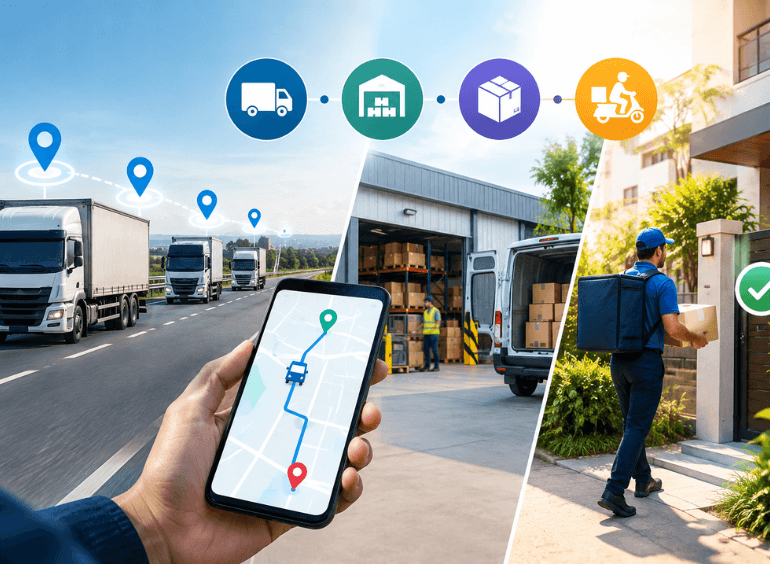
A warehouse updates an order as ready for dispatch. The fleet team assigns a vehicle. The driver receives the delivery details. GPS information updates the trip. The customer receives notifications. The driver records proof of delivery, and the order is closed.
When these steps are connected, businesses spend less time moving information manually from one system or person to another.
That is where the real value lies.
What Businesses Should Prioritise
Not every logistics business needs a complicated technology stack.
The best starting point is usually the problem causing the biggest operational headache.
If managers cannot see vehicles clearly, prioritise GPS tracking.
If drivers are travelling unnecessary distances, improve route optimisation.
If warehouse and transport teams are poorly coordinated, connect dispatch and fleet information.
If customers constantly ask about delivery status, provide real-time tracking and automated notifications.
If payment reconciliation is slow, bring collection updates into the mobile workflow.
Technology works best when it solves a specific problem rather than being introduced simply because it is available.
Faster Deliveries Need Better Planning
Quick commerce has changed customer expectations in cities across India. People are becoming increasingly comfortable with short delivery windows.
But faster is not always better if reliability suffers.
A customer is likely to prefer a delivery that arrives in two hours as promised over one advertised as 30 minutes that arrives much later.
Logistics businesses therefore need to balance speed, cost and reliability.
Better route planning, inventory visibility and warehouse coordination can often improve delivery times without putting unrealistic pressure on drivers.
Sometimes, the smartest way to go faster is to organise better.
What Comes Next for Logistics?
Mobile apps are laying the groundwork for a more connected logistics ecosystem.
Artificial intelligence can help predict demand and potential delays. IoT devices can provide real-time information about vehicles and shipments. Predictive maintenance can identify potential vehicle issues before they become breakdowns.
These technologies can complement mobile applications and make logistics operations increasingly data-driven.
Yet technology cannot remove every real-world challenge.
Traffic will remain unpredictable. Heavy rains can disrupt routes. Customers may not answer calls. A vehicle can still break down at an inconvenient moment.
As the saying goes, even the best-laid plans can go for a toss.
The difference is that a connected logistics operation can identify the problem earlier and respond more quickly.
From the Fleet to the Front Door
The role of logistics apps is expanding far beyond basic fleet tracking.
They are connecting warehouses with vehicles, drivers with operations teams and businesses with customers. GPS tracking provides visibility, route optimisation improves efficiency, digital proof of delivery strengthens accountability and real-time notifications keep everyone informed.
For Indian businesses, this matters because logistics is becoming increasingly central to the customer experience.
A product may be excellent, but if it arrives late, cannot be tracked or gets stuck because of a coordination problem, the customer remembers the delivery experience.
The future of logistics will therefore not be defined only by faster vehicles or larger warehouses. It will also depend on how effectively businesses use information.
From fleet tracking to the last mile, mobile technology is helping turn logistics from a collection of disconnected activities into a more coordinated, visible and responsive operation.