
The Growing Role of Mobile Apps in Modern Retail Business
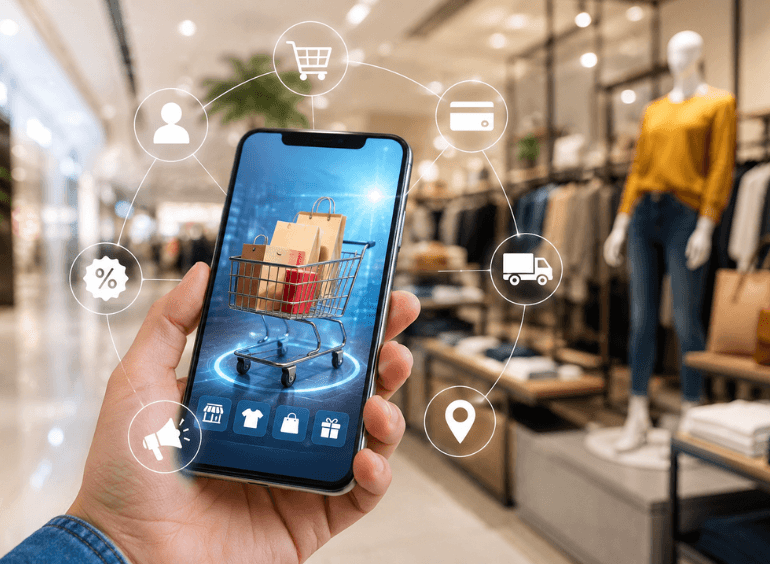
A decade ago, shopping meant walking into a store, browsing the shelves and standing in a queue at the billing counter. Today, a customer in Hyderabad can order groceries while travelling home, pay through UPI, track the delivery and receive a personalised offer — all from a phone. The store may be several kilometres away, but the shopping experience is happening in the customer’s hand.
This shift is changing the retail business in ways that go well beyond online shopping. Mobile apps have become an important connection between retailers and customers, helping businesses understand buying habits, manage inventory, offer convenient payments and keep customers engaged long after they leave the store.
For Indian retailers, this change is particularly significant. Consumers are comfortable switching between physical stores, websites, apps, social media and quick-commerce platforms depending on what they need at that moment. The distinction between online and offline retail is gradually becoming less important. What matters is whether the retailer can provide a smooth experience across both.
Shopping Has Become a Mobile-First Experience
Consider a typical weekend in Bengaluru. A customer may discover a product on Instagram, check its price on a retailer’s app, visit a physical store to see it in person and later place the order online. Another customer in Chennai may prefer visiting a neighbourhood supermarket but use its app to check whether a particular product is available before making the trip.
This behaviour is increasingly common because smartphones have removed many of the small inconveniences associated with shopping.
Customers can compare prices, read reviews, check availability, receive discounts, make payments and track deliveries without having to depend entirely on store staff. Even when the final purchase happens offline, the mobile phone often plays a role somewhere in the journey.
For retailers, this means the mobile app is no longer simply another sales channel. It can become a bridge connecting the customer’s digital and physical experiences.
Personalisation Is Becoming Part of Everyday Shopping
Walk into a traditional shop and the owner may remember that you regularly buy a particular brand of tea or prefer a certain type of rice. Digital retail is trying to recreate that familiarity at a much larger scale.
Retail apps can analyse previous purchases, browsing behaviour, frequently viewed products and shopping frequency to provide more relevant suggestions. A customer who regularly buys skincare products, for instance, may see recommendations related to those purchases rather than a random collection of products.
AI is making these recommendations increasingly sophisticated. Instead of simply saying, “Customers who bought this also bought that,” retailers can use customer behaviour and contextual information to understand what might actually be useful.
This can be particularly valuable during India’s festive shopping seasons. A customer preparing for Diwali may be interested in home décor, electronics and gifts, while someone shopping before Onam, Pongal or Eid may have completely different requirements.
The objective is not to bombard customers with offers. Good personalisation should make shopping easier by reducing the effort involved in finding something relevant.
UPI Has Changed the Checkout Conversation
Mobile retail and digital payments have grown together in India.
UPI has made it remarkably easy for customers to pay at a physical counter, complete an online purchase or pay a delivery partner. A QR code at a neighbourhood shop in Hyderabad can now provide almost the same payment convenience that customers expect from a large organised retailer.
Retail apps can build on this behaviour by integrating multiple payment options and making checkout faster. Saved payment preferences, digital wallets, UPI and one-click purchasing can reduce friction, particularly for repeat customers.
This matters because small inconveniences can make customers abandon a purchase. If finding a product is easy but the checkout process takes too long, the entire experience suffers.
The lesson for retailers is fairly simple: convenience should continue until the very last tap.
Loyalty Programmes Are Moving Beyond Points
Traditional loyalty programmes often revolved around membership cards, stamps and points. Mobile apps have made them much more dynamic.
A retailer can now send a customer a reward shortly before their usual purchase cycle, provide app-exclusive offers or create personalised loyalty benefits. Customers can see their points, vouchers and previous purchases without keeping track of physical cards.
But retailers need to be careful here. Sending notifications every few hours is unlikely to build loyalty. It can do quite the opposite.
Customers appreciate messages that are useful — a reminder about an expiring coupon, a relevant offer or an update about an order. They are less likely to appreciate endless promotional notifications.
The best loyalty strategy is therefore not about sending more messages. It is about making each interaction more meaningful.
Inventory Visibility Can Solve a Very Real Problem
Few things are more frustrating than finding a product online, travelling to the store and discovering that it is out of stock.
Mobile apps can help retailers address this by connecting customer-facing platforms with inventory systems. When implemented properly, customers can check whether a product is available at a nearby store, reserve it for pickup or order it for delivery.
Imagine a customer in Mumbai looking for a particular pair of shoes. Instead of visiting three branches, the customer could check availability across stores and head directly to the location that has the right size.
For retailers, inventory visibility also provides operational advantages. Better information about stock levels can help reduce overstocking, identify fast-moving products and improve replenishment decisions.
This is where technology quietly makes a difference. Customers may never see the inventory system, but they notice when it works — and especially when it does not.
Quick Commerce Has Raised Customer Expectations
The rise of quick commerce has changed what Indian consumers consider “fast”.
In cities such as Bengaluru, Delhi and Hyderabad, customers have become accustomed to ordering everyday essentials and receiving them within a short period. While not every retail business needs to compete on delivery speed, the expectation of convenience has spread across the industry.
Customers increasingly ask:
- Can I find the product quickly?
- Can I know whether it is in stock?
- Can I order from my nearest store?
- Can I choose a delivery slot?
- Can I collect it myself?
- Can I track my order?
These expectations are influencing conventional retailers as well.
A neighbourhood supermarket may not operate like a quick-commerce company, but it can still offer digital ordering, local delivery or click-and-collect services. In many cases, the advantage of a local retailer is proximity and familiarity. Digital tools simply help the business make better use of those strengths.
Omnichannel Retail Is Becoming the New Normal
The customer does not necessarily care whether a purchase is classified as “online” or “offline”. They simply want the easiest way to buy.
This is why omnichannel retail has become important.
A customer might browse through an app, visit a store, purchase through the website and later contact customer support through the app. Another might buy online and return the product at a physical outlet.
For retailers, creating this experience requires more than launching an app. Product information, prices, inventory, customer accounts, orders and returns need to work together.
This is one reason Retail App Development has increasingly become connected with broader retail technology rather than being treated as an isolated mobile project. The real challenge is making the app work as part of the retailer’s larger ecosystem.
Customer Engagement Does Not End After the Purchase
Retail apps also give businesses a direct way to remain connected with customers.
Order updates, product-care information, reminders, feedback requests, loyalty rewards and personalised recommendations can all continue the relationship after checkout.
For example, someone who purchases a washing machine may later receive information about installation, warranty services or compatible accessories. A customer purchasing groceries regularly may receive reminders based on shopping patterns.
Used sensibly, this creates a more useful relationship between retailer and customer. The app becomes less like a digital catalogue and more like a shopping companion.
Again, restraint matters. Nobody wants their phone buzzing constantly with “limited-time offers”.
Data Is Changing How Retailers Make Decisions
One of the biggest advantages of mobile retail is the amount of behavioural information it can generate.
Retailers can understand which products customers search for, which offers attract attention, where customers drop out of the purchase journey and how often they return.
This information can influence decisions about pricing, promotions, product placement and inventory.
Suppose a retailer notices that customers in one Hyderabad neighbourhood frequently search for a product but rarely complete the purchase because it is unavailable. That information is more useful than simply knowing that the product sold poorly. It could indicate a stock or assortment problem.
Similarly, if customers repeatedly add an item to their cart after seeing a promotion but do not complete the purchase, the retailer may need to examine pricing, delivery charges or checkout friction.
The value of data is therefore not in collecting huge amounts of it. The real value lies in turning it into better decisions.
Local Retailers Are Part of This Change Too
Digital retail is not limited to large chains.
Small retailers and family-run businesses are also finding ways to use smartphones for customer orders, digital payments, delivery coordination and customer communication.
A local clothing shop in Chennai might share new arrivals through WhatsApp. A grocery store in Hyderabad may accept orders digitally from regular customers. A neighbourhood electronics dealer in Delhi may use online listings to reach customers beyond its immediate locality.
These businesses do not necessarily need to copy the technology strategy of a large e-commerce company. Their strength often lies in personal relationships, local knowledge and trust.
The opportunity is to use digital tools without losing those qualities.
What Retailers Should Focus On Next
Simply having an app is not enough. Customers have little patience for apps that are slow, confusing or filled with irrelevant notifications.
Retailers planning their mobile strategy should focus on a few fundamentals.
Make discovery simple. Customers should be able to search, filter and compare products without unnecessary steps.
Keep information accurate. Prices, product details and stock availability need to match reality as closely as possible.
Make payments effortless. UPI and other familiar payment options should be integrated into a straightforward checkout experience.
Connect online and offline operations. Customers should be able to move between the app and physical stores without feeling as though they are dealing with two different businesses.
Use customer data responsibly. Personalisation works only when customers trust the retailer with their information.
Measure what actually matters. Downloads alone do not indicate success. Repeat purchases, customer retention, conversion rates and satisfaction provide a much clearer picture.
The Retail Store Is Not Disappearing
Despite the growth of mobile commerce, physical retail remains deeply important in India.
People still like trying clothes before buying them, checking the quality of fresh produce, testing electronics and speaking to shop staff. Shopping is also a social activity for many families, particularly during festivals and special occasions.
What is changing is the relationship between the store and the smartphone.
The store may become the place where customers experience a product, while the app handles ordering and delivery. Or the app may bring customers into a physical store through personalised offers and location-based information. In another case, the store may simply serve as a convenient fulfilment point for an online order.
The boundaries are becoming increasingly fluid.
A More Connected Future for Retail
Mobile apps have moved retail from a largely transaction-based relationship towards a more continuous one. Customers can interact with a retailer before, during and after a purchase, while retailers can respond to changing preferences much faster than before.
For Indian businesses, the next phase will not be about choosing between online and offline retail. It will be about bringing the two together in a way that feels natural to customers.
A shopper in Hyderabad, Bengaluru, Mumbai, Delhi or Chennai may not think about the technology behind the experience. They simply want the right product, at the right price, available when they need it, with a payment and delivery process that does not waste their time.
That is ultimately where mobile apps are making their biggest impact. They are not replacing retail; they are quietly changing how retail fits into everyday life. And as customer expectations continue to rise, retailers that understand this shift will be better placed to keep up — one tap, one purchase and one customer