

Creative Testing Techniques that Improve Click Through Rate
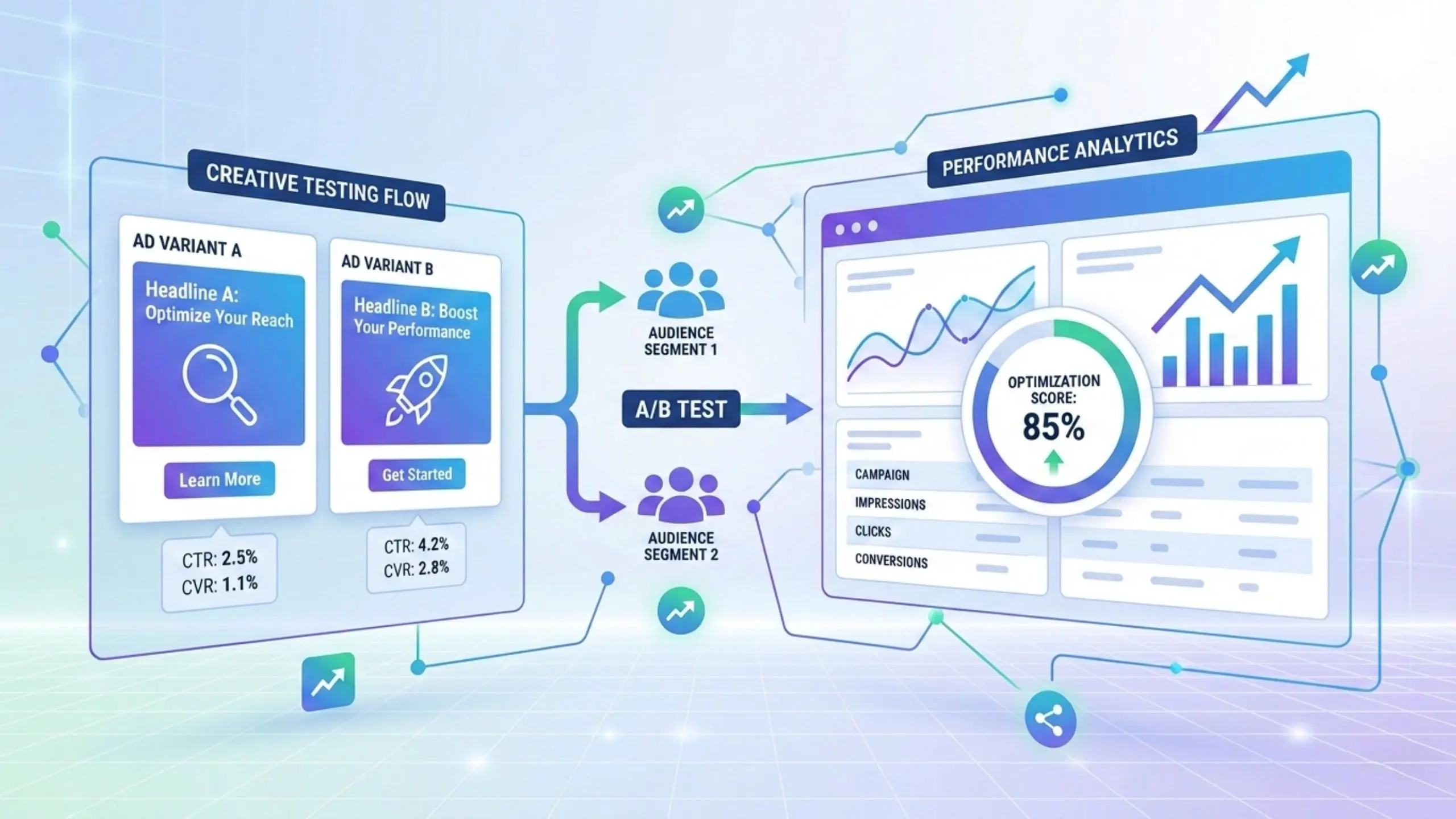
The digital advertising landscape has transformed dramatically over recent years. What once delivered consistent results now struggles to capture attention. Rising competition across every vertical, saturated audiences bombarded with thousands of messages daily, and increasingly sophisticated platform algorithms have fundamentally changed how performance marketers must approach campaign success.
Creative testing is no longer optional. It has become the foundation of sustainable PPC and performance marketing growth. When every advertiser competes for the same audience attention, the quality and relevance of your ad creative directly determines whether your campaigns thrive or decline.
Why Creative Testing Has Become Essential for Performance Marketing
Platform algorithms prioritize engagement signals. Facebook, Google, LinkedIn, and other advertising networks reward ads that generate higher click-through rates, lower bounce rates, and stronger conversion actions. When your creative fails to resonate, the algorithm recognizes this through declining engagement metrics and increases your cost per click while reducing delivery.
Audience saturation compounds this challenge. Users develop banner blindness and scroll past generic messaging. The creative that performed exceptionally six months ago now generates diminishing returns as audiences become desensitized. Without systematic testing and iteration, even well-funded campaigns experience performance decay.
Competition intensity continues escalating. More advertisers enter profitable markets, bidding up auction prices and forcing efficiency improvements. The only sustainable competitive advantage comes from superior creative performance. Brands that master creative testing maintain lower acquisition costs and stronger return on ad spend while competitors struggle with rising CPCs and declining conversion rates.
1. Structured A/B Testing: The Foundation of Creative Optimization
A/B testing forms the bedrock of scientific creative optimization. This methodology isolates individual creative variables to measure their specific impact on campaign performance. Rather than making subjective creative decisions, structured A/B testing provides empirical evidence about what drives results.
The process requires discipline. Test one variable at a time to ensure clean data. When comparing two ad variations, change only the headline while keeping all other elements constant. This isolation allows you to attribute performance differences specifically to the tested element rather than confounding variables.
Statistical significance matters. Running tests for insufficient duration or with inadequate impression volume produces unreliable conclusions. Aim for at least 100 conversions per variation before declaring a winner, though this threshold varies based on your baseline conversion rate and risk tolerance.
Creative elements to A/B test systematically include headlines, primary text length, call-to-action phrasing, visual composition, color schemes, and value proposition framing. Document every test result to build institutional knowledge about what resonates with your specific audience.
2. Multivariate Creative Experiments: Testing Multiple Variables Simultaneously
Multivariate testing accelerates learning by examining multiple creative variables concurrently. While A/B testing compares complete ad variations, multivariate experiments analyze how different combinations of creative elements perform together.
This approach proves particularly valuable when you need to optimize multiple campaign components quickly. By testing various headline and image combinations simultaneously, you identify which pairings generate the strongest synergistic effect rather than just which individual elements perform best in isolation.
Platform dynamic creative optimization tools facilitate multivariate testing. Facebook’s DCO automatically tests combinations of uploaded headlines, images, descriptions, and CTAs to determine optimal pairings. Google’s responsive search ads serve similar functionality by rotating headline and description combinations to maximize performance.
The challenge lies in interpretation. Multivariate tests require substantially higher traffic volume to reach statistical significance across all tested combinations. Start with fewer variables if your account lacks sufficient impression volume to power comprehensive multivariate experiments.
3. Headline and CTA Optimization: The Highest-Impact Creative Elements
Headlines and calls-to-action represent the most critical creative components for performance. These elements directly influence whether users engage with your ad and take desired actions.
Headline testing should explore different value proposition angles. Compare benefit-driven headlines against feature-focused ones. Test question-based headlines versus declarative statements. Experiment with specificity by including numbers, percentages, or timeframes that create concrete expectations.
Urgency and scarcity often improve performance when authentic. Headlines incorporating limited availability or time-sensitive offers typically generate higher CTR, provided the urgency reflects genuine business conditions rather than manufactured pressure. Audiences have developed sophisticated detection for inauthentic scarcity tactics.
CTA optimization extends beyond simple button text. Test direct action language like “Get Started Now” against softer engagement prompts like “Learn More.” Evaluate whether including friction-reducing qualifiers such as “Free Trial” or “No Credit Card Required” improves conversion rates despite potentially lowering initial click volume.
Position and visual prominence matter. CTAs placed above the fold with contrasting colors that draw eye attention typically outperform buried or camouflaged action buttons. However, test these assumptions with your specific audience rather than accepting conventional wisdom blindly.
4. Visual and Video Creative Testing: Engaging Audiences Through Imagery
Visual creative represents your first opportunity to stop the scroll. Static images, carousel ads, and video content each serve distinct purposes and require tailored testing approaches.
Image testing should examine both composition and subject matter. Compare lifestyle photography showing product usage against clean product shots on neutral backgrounds. Test whether human faces in imagery improve engagement through social connection or create distraction from the core message.
Color psychology influences perception and action. Warmer colors often convey energy and urgency while cooler tones suggest trustworthiness and professionalism. Test color variations systematically to understand what resonates with your audience demographic and aligns with your brand positioning.
Video creative introduces additional variables including length, pacing, audio strategy, and hook effectiveness. The first three seconds determine whether viewers continue watching or scroll past. Test different opening hooks aggressively, as this single element often determines video ad success more than production quality or content depth.
Sound-off viewing dominates mobile environments. Video ads must communicate value through visual storytelling and text overlays even when audio doesn’t play. Test sound-off optimization explicitly rather than assuming users will enable audio.
5. Audience-Specific Messaging: Personalizing Creative for Segmented Groups
Generic messaging appeals to everyone and resonates with no one. Audience segmentation paired with customized creative dramatically improves relevance and performance.
Demographic targeting enables creative customization. An ad promoting retirement planning should feature different imagery, messaging, and value propositions when targeting 35-year-olds versus 55-year-olds. Life stage, income level, and geographic location all inform creative decisions.
Behavioral segmentation allows even more precise personalization. Users who visited your website previously see different creative than cold audiences. Those who abandoned shopping carts receive remarketing ads with specific objection handling or incentive offers tailored to their demonstrated interest level.
Awareness stage dramatically impacts creative effectiveness. Cold audiences require educational content that establishes problem recognition and introduces your solution. Warm audiences who understand their need respond to differentiation messaging. Hot audiences near purchase decisions engage with conversion-focused creative emphasizing specific offers, guarantees, or urgency.
Test messaging frameworks across segments to identify which approaches work for each audience type. Document these insights to inform future campaign launches and creative development priorities.
6. Landing Page Consistency: Aligning Post-Click Experience With Ad Promises
Creative testing cannot stop at the ad level. The landing page experience directly impacts conversion rates and determines whether strong click-through performance translates into revenue results.
Message match between ad creative and landing page headlines creates cognitive consistency that improves conversion. When your ad promises a specific benefit or offer, the landing page must immediately confirm that promise above the fold. Discontinuity forces users to search for relevance, increasing friction and abandonment.
Visual consistency reinforces brand recognition and trust. Landing pages should echo ad creative’s color schemes, imagery style, and design language. This coherence creates a seamless experience that feels like a natural progression rather than a disconnected jump.
Offer consistency matters most. If your ad advertises a 30% discount, the landing page must prominently display that exact offer. Any discrepancy between promised and delivered value destroys trust and obliterates conversion rates regardless of traffic quality.
Test landing page variations systematically just as you test ad creative. Evaluate different hero image approaches, headline formulations, form lengths, social proof positioning, and CTA placement to optimize the complete conversion funnel rather than just the entry point.
7. Performance-Based Creative Scaling: Amplifying What Works
Creative testing generates insights. Creative scaling converts those insights into revenue growth. Identifying winning variations means nothing unless you systematically allocate budget toward proven performers and away from underperforming creative.
Establish clear performance thresholds that trigger scaling decisions. Define minimum CTR, conversion rate, and ROAS benchmarks that creative must achieve to receive increased investment. This data-driven approach removes subjective decision-making and ensures resources flow toward measurable results.
Creative refresh cadence prevents ad fatigue. Even winning creative eventually exhausts audience interest through overexposure. Monitor frequency metrics closely and introduce new variations before performance deteriorates. Proactive refresh maintains momentum while reactive replacement recovers from decline.
Winning creative principles inform rapid iteration. When specific headlines, visual approaches, or messaging angles consistently outperform alternatives, apply those learnings across new creative variations. This systematic knowledge transfer accelerates the development of future winning creative.
Retirement timing matters as much as scaling timing. Pause underperforming creative decisively rather than allowing poor performers to drain budget. Set automated rules that stop delivery when creative falls below minimum performance thresholds, freeing resources for better-performing variations.
Managing Ad Fatigue and Creative Burnout
Ad fatigue represents one of the most common performance killers in sustained campaigns. As audiences see the same creative repeatedly, engagement metrics decline, cost per action increases, and campaign efficiency deteriorates.
Frequency monitoring provides early warning signals. When average frequency exceeds 3-4 impressions per user in shorter campaign periods, creative fatigue likely contributes to declining performance. Platform reporting shows frequency metrics that should inform creative refresh decisions.
Creative rotation strategies combat fatigue. Rather than relying on a single winning ad, maintain a portfolio of 3-5 high-performing variations in active rotation. This diversity reduces individual ad exposure while maintaining overall campaign performance.
Seasonal relevance requires creative updates. Holiday-specific messaging, weather-related promotions, and culturally timely references all have natural expiration dates. Update creative proactively to maintain relevance rather than waiting for performance signals to indicate staleness.
Creative burnout extends beyond individual ads to broader creative approaches. When your overall visual style, messaging framework, or value proposition positioning becomes stale across the entire creative portfolio, even new variations following the same formula will underperform. Periodically test radically different creative approaches to prevent systematic burnout.
Data-Driven Decision Making and Analytics Validation
Creative intuition has value, but data validation provides certainty. Every creative decision should ultimately be validated through performance metrics rather than aesthetic preferences or subjective opinions.
Establish clear KPI hierarchies. Click-through rate indicates ad relevance and stopping power. Landing page conversion rate measures post-click experience quality. Cost per acquisition determines commercial viability. ROAS or ROMI quantifies ultimate business impact. Track the complete funnel to understand where creative drives value and where it fails.
Attribution complexity requires careful interpretation. Last-click attribution often misrepresents creative contribution by ignoring assisted conversions. Multi-touch attribution models provide more comprehensive understanding of how different creative executions contribute to the conversion journey.
Cohort analysis reveals creative performance over time. Initial strong performance that deteriorates in days 7-30 post-impression suggests creative attracted low-intent users or set incorrect expectations. Creative that improves performance in later cohorts indicates stronger long-term value despite potentially lower immediate metrics.
Statistical rigor prevents false conclusions. Declaring winners prematurely based on insufficient data leads to poor decisions. Use significance testing tools and respect minimum sample size requirements before making scaling decisions based on test results.
Realistic Performance Expectations and Ethical Advertising Practices
Sustainable performance requires realistic goal-setting informed by industry benchmarks and channel characteristics. Inflated expectations lead to premature campaign abandonment or unethical tactics that damage brand reputation.
Industry CTR benchmarks vary substantially by platform, format, and vertical. Google Search ads typically achieve 3-8% CTR, while display advertising averages 0.5-1%. Facebook feed ads commonly generate 1-3% CTR. Understanding these baselines calibrates expectations and helps identify genuinely strong performance.
Conversion rate context matters. Landing page conversion rates for cold traffic typically range from 2-5% for most industries, while remarketing audiences may convert at 10-20% or higher. These benchmarks vary by industry, offer type, and traffic quality, but provide reasonable reference points.
Ethical advertising principles must govern creative testing. Avoid manipulative psychological tactics, false scarcity, misleading claims, or aggressive targeting of vulnerable populations. Short-term conversion gains from unethical practices create long-term brand damage and legal liability that far outweigh temporary performance improvements.
Transparency with audiences builds trust that compounds over time. Clear value propositions, honest offer terms, straightforward pricing information, and authentic customer testimonials generate sustainable performance by attracting genuinely interested prospects rather than maximizing click volume from misled users.
Building a Systematic Creative Testing Framework
Isolated tests provide limited value. Systematic creative testing frameworks compound insights over time to continuously improve campaign performance and build competitive advantages.
Testing calendars ensure consistent experimentation. Dedicate specific campaign percentages to ongoing testing while maintaining proven creative in majority rotation. This balanced approach enables learning without sacrificing current performance.
Documentation systems capture institutional knowledge. Record every test hypothesis, methodology, results, and key learnings in accessible repositories. This knowledge base informs future testing priorities and prevents repetitive testing of already-validated insights.
Cross-functional collaboration improves creative quality. Performance marketers understand platform mechanics and audience behavior but may lack design expertise or persuasive copywriting skills. Regular collaboration with creative teams produces better testing variations than either function generates independently.
Iterative improvement cycles build momentum. Each testing cycle should incorporate learnings from previous experiments to generate increasingly refined hypotheses. This cumulative approach accelerates performance improvement compared to random testing approaches.
Transform Your PPC Performance Through Disciplined Creative Testing
Creative testing separates high-performing campaigns from stagnant ones. In an environment where competition intensifies, audiences develop resistance to generic messaging, and platform algorithms reward engagement, your creative quality directly determines campaign success.
The methodologies outlined here provide a structured approach to creative optimization. A/B testing, multivariate experiments, audience-specific personalization, landing page alignment, and performance-based scaling create a comprehensive framework for driving sustainable click-through and conversion growth.
However, implementing these practices requires expertise, resources, and consistent execution. Many businesses lack the dedicated personnel or technical infrastructure to conduct rigorous creative testing alongside their operational responsibilities.
Ozrit’s PPC Services delivers the specialized expertise and systematic approach needed to maximize your paid advertising performance. Our team applies disciplined creative testing methodologies, advanced analytics validation, and continuous optimization to drive measurable improvements in click-through rates, conversion rates, and return on ad spend.
We implement structured testing frameworks tailored to your business objectives, industry dynamics, and audience characteristics. Our data-driven approach identifies winning creative variations, scales proven performers, and continuously refreshes your creative portfolio to combat ad fatigue and maintain competitive performance.
Beyond creative testing, we provide comprehensive PPC management across Google Ads, Meta platforms, LinkedIn, and other performance channels. Our services integrate strategic account architecture, bidding optimization, audience segmentation, and landing page analysis to optimize your complete conversion funnel.
Partner with Ozrit to transform your PPC performance through proven creative testing techniques and transparent, results-focused campaign management. Contact us today to discuss how our performance marketing expertise can drive sustainable growth for your business.