
Amazon’s Alexa+ Signals a New Phase of AI Assistants
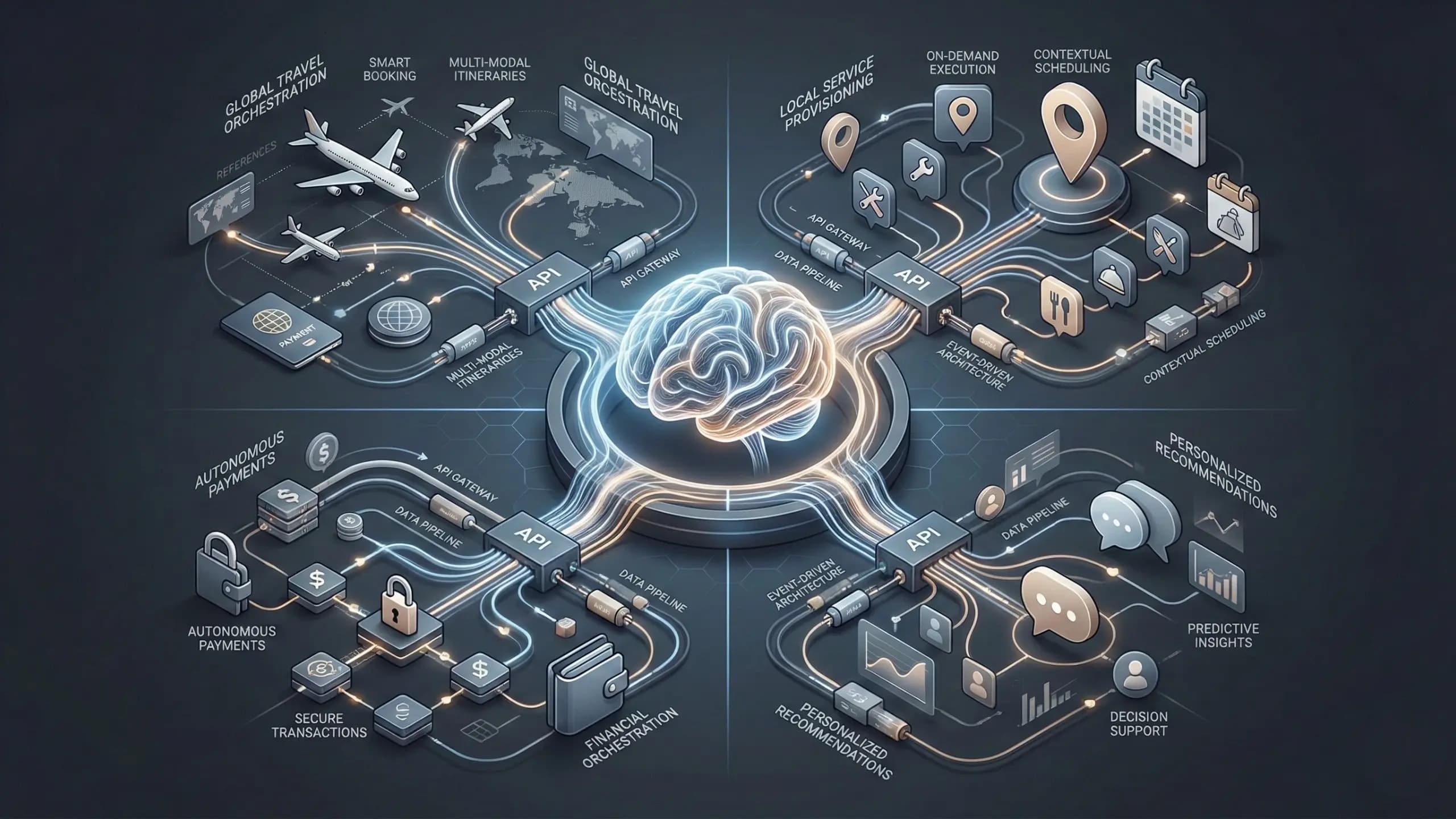
Amazon’s latest announcement regarding Alexa+ marks a significant inflection point in the evolution of intelligent assistants. The integration with Angi, Expedia, Square, and Yelp represents more than incremental feature expansion; it signals a fundamental shift in how AI development services assistants operate within digital ecosystems.
For years, voice assistants have been confined to narrow utility: setting timers, answering trivia, and controlling smart home devices. These functions, while convenient, rarely delivered transformative value. Alexa+ changes that equation by moving from passive response to active execution. When a user asks Alexa+ to find a plumber, book a flight, or recommend a nearby restaurant, the assistant doesn’t just surface information; it completes transactions, schedules appointments, and orchestrates multi-step workflows across external platforms.
This article examines what makes Alexa+ different, analyzes the strategic implications of each integration, and explores what this shift means for enterprises building their own AI capabilities.
Inside Alexa+: From Conversational AI to Action-Oriented Intelligence
The distinction between Alexa and Alexa+ lies not in better speech recognition or more natural language processing, but in architectural philosophy. Earlier iterations of Alexa prioritized conversational interfaces, understanding what users said and responding appropriately. Alexa+ prioritizes outcome completion, understanding what users want and executing the necessary steps to deliver it.
This shift manifests in three core capabilities that separate Alexa+ from its predecessors and competitors.
Context Awareness Across Sessions
Alexa+ maintains conversational state not just within a single interaction, but across sessions and platforms. If a user asks about flights to Miami on Monday and follows up days later asking about hotels, Alexa+ recognizes the connection and contextualizes recommendations accordingly. This persistent context awareness enables the assistant to function less like a search interface and more like a knowledgeable concierge who remembers preferences and ongoing needs.
Traditional assistants treated each query as isolated. Alexa+ treats queries as connected threads in an ongoing relationship, allowing for more sophisticated task delegation and reducing the cognitive load on users who no longer need to constantly re-establish context.
API-Based Action Execution
The integrations with Angi, Expedia, Square, and Yelp aren’t superficial data feeds; they’re deep API connections that allow Alexa+ to execute actions within those platforms. When properly authorized, Alexa+ can initiate bookings, process payments, schedule services, and manage reservations without requiring users to switch contexts or complete workflows manually.
This API-first approach transforms Alexa+ from an information retrieval system to a task completion engine. The assistant becomes a frontend interface to backend systems, abstracting away the complexity of navigating multiple apps, websites, and service portals. For users, friction disappears. For platforms, Amazon becomes an essential distribution channel.
Multi-Step Task Orchestration
Perhaps most significantly, Alexa+ can chain together multiple discrete actions into coherent workflows. Planning a weekend trip doesn’t just involve searching for flights; it requires coordinating transportation, lodging, dining reservations, and activities. Alexa+ can manage this orchestration, checking availability across services, handling dependencies, and presenting users with cohesive options rather than fragmented results.
This capability represents a fundamental architectural advancement. Earlier assistants could perform individual tasks. Alexa+ can manage processes, sequences of related tasks that together accomplish a meaningful goal. This distinction matters enormously for enterprise adoption, where business processes rarely consist of single, isolated actions.
Use-Case Breakdown: What These Integrations Actually Enable
Understanding the strategic value of Alexa+ requires examining what each integration specifically enables and why Amazon selected these partners.
Angi: Transforming Home Service Discovery
The Angi integration addresses one of the most friction-filled consumer experiences: finding and hiring home service professionals. Traditional discovery involves browsing listings, reading reviews, comparing prices, checking availability, and initiating contact, often across multiple sessions and platforms.
Alexa+ collapses this workflow. A user describing a leaky faucet or needed electrical work triggers an intelligent matching process. The assistant evaluates requirements, queries Angi’s database of service providers, filters by availability and ratings, and can even initiate booking, all through natural conversation.
This transforms Angi from a marketplace users visit when they need help into an ambient infrastructure that activates when needs arise. For Angi, the integration represents critical distribution as users increasingly expect AI development services assistants to handle service discovery. For Amazon, it demonstrates Alexa+’s ability to manage high-consideration, trust-dependent transactions.
Expedia: Conversational Travel Planning
Travel planning represents another domain plagued by fragmentation. Users typically bounce between flight search engines, hotel booking sites, car rental platforms, and activity planners, managing availability constraints, price comparisons, and logistical dependencies manually.
The Expedia integration enables consolidated travel orchestration through Alexa+. Users can describe trip parameters in natural language, destinations, dates, budget constraints, preferences, and receive coordinated options spanning flights, accommodations, and ground transportation. More importantly, Alexa+ can manage the booking workflow, handling payment processing and confirmation management without context switching.
For frequent travelers, the integration offers continuity. Alexa+ can reference past trips, understand preferences like aisle seats or hotel chains, and proactively suggest relevant options. This personalization layer, built atop Expedia’s inventory infrastructure, creates stickiness that benefits both Amazon and Expedia while improving user experience.
Square: Enabling Frictionless Commerce
The Square integration represents Alexa+’s most direct play into transaction facilitation. Square’s ecosystem spans point-of-sale systems, payment processing, and small business infrastructure, making it an ideal partner for enabling voice-initiated commerce.
Through this integration, Alexa+ can initiate payment transactions, confirm orders, and manage purchase workflows for businesses using Square’s platform. A user at a coffee shop could theoretically complete payment through Alexa+ without physical interaction, or pre-order from a restaurant and authorize payment through voice commands.
The strategic implications extend beyond consumer convenience. By integrating with Square, Amazon positions Alexa+ as infrastructure for small and medium businesses looking to offer voice-activated services. A local retailer using Square for payment processing automatically gains access to Alexa+’s user base and conversational commerce capabilities.
This mirrors Amazon’s broader strategy: make Alexa+ indispensable to businesses by providing access to customers who increasingly prefer AI-mediated interactions. For Square merchants, the integration reduces barriers to adopting conversational commerce. For Amazon, it expands Alexa+’s transactional footprint beyond its own retail ecosystem.
Yelp: Context-Aware Local Discovery
The Yelp integration addresses local business discovery and recommendation, a use case where AI assistants have historically underperformed due to generic, context-free results.
Alexa+ changes this by combining Yelp’s business database and review corpus with sophisticated contextual understanding. A user asking for “somewhere good for dinner” triggers analysis of location, time, past preferences, dietary restrictions mentioned in previous conversations, and current context cues. The assistant doesn’t just return top-rated restaurants; it delivers personalized recommendations with reasoning.
The review-driven recommendation layer proves particularly powerful. Rather than simply displaying star ratings, Alexa+ can parse review text to answer specific questions: “Do they have outdoor seating?” “Is it good for large groups?” “How’s the service?” This transforms static review databases into conversational intelligence that responds to nuanced queries.
For Yelp, the integration ensures relevance as discovery shifts toward AI assistants. Users accustomed to asking Alexa+ for recommendations may never visit Yelp’s website or app, making the integration essential for maintaining user reach. For Amazon, it demonstrates Alexa+’s ability to handle subjective, preference-driven recommendations, not just objective data retrieval.
The Bigger Trend: AI Assistants Becoming Digital Operators
The Alexa+ integrations exemplify a broader transformation in how AI assistants function within digital ecosystems. We’re witnessing a shift from assistance to operation, from systems that help users complete tasks to systems that complete tasks autonomously.
This evolution reflects several converging technological and market forces. Large language models have dramatically improved natural language understanding, enabling assistants to parse complex intent from casual conversation. API ecosystems have matured, providing standardized interfaces for system integration. Consumer expectations have risen, driven by experiences with sophisticated AI tools that reduce friction and anticipate needs.
The result is a new category of AI agent that operates at the intersection of conversation and automation. These systems don’t just answer questions; they execute workflows, manage transactions, and orchestrate processes across multiple platforms. Google Assistant, ChatGPT plugins, and various enterprise AI agents are all moving in this direction, but Amazon’s platform reach and commercial infrastructure give Alexa+ significant advantages.
The API-First Architecture Standard
Underlying this trend is the emergence of API-first design as the standard for AI integration. Modern AI assistants don’t scrape websites or simulate user actions; they connect directly to backend systems through well-defined APIs. This approach ensures reliability, enables transaction security, and allows for sophisticated state management that surface-level integration cannot achieve.
For businesses, this creates both opportunity and pressure. Platforms with robust API infrastructure can integrate with AI assistants and reach users through conversational interfaces. Those without a face are growing irrelevant as users migrate toward AI-mediated discovery and task completion. The Alexa+ partners, Angi, Expedia, Square, and Yelp, all maintain sophisticated API platforms, which is precisely why these integrations deliver genuine utility rather than superficial features.
Trust, Accuracy, and System Reliability
The transition from assistance to operation raises the stakes for accuracy and reliability. When AI assistants merely surface information, errors result in wasted time. When they execute transactions and initiate workflows, errors result in financial loss, missed reservations, and broken processes.
This places enormous pressure on both the AI layer and the integrated systems. Alexa+ must correctly interpret intent, validate actions before execution, and handle error conditions gracefully. Partner platforms must maintain API reliability, ensure data accuracy, and provide clear feedback channels. The entire stack must function with reliability approaching traditional transactional systems.
Trust becomes the limiting factor. Users will only delegate high-stakes tasks, booking flights, hiring contractors, and authorizing payments, to AI assistants they trust to execute correctly. Building that trust requires consistent performance over time, transparent operation, and robust error handling. Amazon’s brand reputation and infrastructure investments position Alexa+ well for this challenge, but maintaining trust at scale remains an open question.
What This Means for Businesses and Platforms
The Alexa+ integrations carry significant implications for businesses across multiple sectors. As AI assistants evolve into transactional interfaces, companies must adapt their distribution strategies, technical infrastructure, and user experience assumptions.
The New Distribution Layer
For SaaS platforms, marketplaces, and service providers, AI assistants represent an emerging distribution channel that could rival mobile apps and websites in importance. Users increasingly expect to accomplish tasks through conversation with AI rather than navigating complex interfaces. Businesses inaccessible through major AI assistants risk becoming invisible to this growing user segment.
This creates pressure to develop robust API infrastructure and integration strategies. Companies must make their services discoverable and actionable through conversational interfaces, which often requires rethinking information architecture and workflow design. A website optimized for browsing may translate poorly to voice-first interaction, necessitating parallel experiences optimized for different modalities.
Backend Integration Complexity
While consumer-facing AI interactions appear simple, the backend integration complexity is substantial. Connecting an AI assistant to business systems requires secure authentication, reliable API endpoints, comprehensive data validation, error handling, and often real-time inventory or availability management.
This complexity creates barriers to entry that favor established platforms with mature infrastructure. Angi, Expedia, Square, and Yelp can integrate with Alexa+ because they’ve invested in API-first architectures and have technical resources to maintain integration quality. Smaller competitors without similar infrastructure face disadvantages in an AI-mediated discovery landscape.
Data Security and Privacy Considerations
AI assistant integrations inherently involve data sharing across organizational boundaries. When Alexa+ books a flight through Expedia or initiates a Square payment, user data flows between Amazon’s systems and partner platforms. This raises questions about data governance, privacy protection, and regulatory compliance.
The trust relationships involved extend beyond individual transactions. Users must trust Amazon to handle their data responsibly, trust partner platforms to deliver services reliably, and trust that the integrated system provides security equivalent to direct platform access. Any breach in this trust chain damages all participants.
Evolving User Experience Expectations
Perhaps most significantly, the rise of AI assistants as transactional interfaces fundamentally changes user experience expectations. Users accustomed to booking travel through conversation with Alexa+ will find manual website navigation increasingly cumbersome. Those who schedule home repairs through voice commands will resent apps that require multiple screens to accomplish the same task.
The implication is that AI readiness becomes a competitive differentiator. Companies that can integrate with leading AI assistants, provide reliable conversational interfaces, and deliver seamless experiences across modalities will capture disproportionate user attention in an increasingly AI-mediated economy.
The Growing Demand for Custom AI Development
As businesses recognize AI assistants as critical infrastructure rather than experimental features, demand accelerates for custom AI development that addresses specific business requirements and workflows.
Generic AI tools, off-the-shelf chatbots, pre-built integrations, and standard virtual assistants provide baseline capabilities but rarely align perfectly with unique business processes, industry-specific requirements, or differentiated customer experiences. Companies serious about AI adoption increasingly require custom development that translates strategic vision into operational reality.
Beyond Generic Chatbots
Early enterprise AI adoption focused heavily on customer service chatbots, scripted conversational interfaces designed to handle common support queries. While these tools provide value for high-volume, repetitive interactions, they represent only a fraction of AI’s potential business impact.
A logistics company might need AI that optimizes routing based on real-time constraints and historical patterns. A healthcare provider might require conversational AI that guides patients through symptom assessment while maintaining HIPAA compliance. A financial services firm might benefit from AI that analyzes transaction patterns to identify fraud while minimizing false positives. Each use case demands custom development tailored to specific requirements.
AI-Powered Workflow Automation
One of the highest-impact applications of custom AI involves automating business workflows that currently require human judgment. Unlike rule-based automation that follows predetermined logic, AI-powered automation can handle ambiguity, adapt to context, and make decisions based on learned patterns.
Building these systems requires custom development because workflows vary significantly across organizations. Industry-specific regulations, company policies, existing system integrations, and cultural factors all shape how automation should function. Generic tools lack the flexibility to accommodate these variations without extensive configuration that often proves more complex than custom development.
Conversational Intelligence for Specialized Domains
While general-purpose AI assistants like Alexa+ excel at broad consumer applications, many businesses require conversational AI tuned to specialized domains with industry-specific language, knowledge requirements, and interaction patterns.
A commercial real estate platform might need conversational AI that understands property terminology, local market dynamics, and investment analysis concepts. A medical device manufacturer might require AI that guides clinicians through troubleshooting procedures using precise technical language. A legal services firm might benefit from conversational tools that help attorneys navigate case law and precedent research.
These specialized applications demand custom development that incorporates domain expertise, trains on relevant data, and optimizes for specific interaction patterns. Building them requires collaboration between AI engineers who understand technical capabilities and domain experts who understand business requirements, a combination rarely available in off-the-shelf solutions.
Integration with Enterprise Systems
Perhaps the most complex aspect of custom AI development involves integrating AI capabilities with existing enterprise systems, CRM platforms, ERP systems, data warehouses, legacy applications, and third-party services. AI assistants only deliver value when they can access relevant data and execute meaningful actions, which requires deep integration with business-critical systems.
Generic AI tools typically offer limited integration capabilities focused on common platforms. Custom development provides the flexibility to connect with specialized systems, accommodate legacy infrastructure, and build integration patterns optimized for specific technical environments.
How Ozrit Enables AI-Driven Experiences
As businesses navigate the complexity of AI adoption, specialized development partners become essential for translating strategic vision into operational capabilities. Ozrit AI Development Services functions as a technology partner for organizations building custom AI solutions that address specific business requirements.
Ozrit’s approach centers on understanding business context before recommending technical solutions. Rather than defaulting to trendy technologies, the focus remains on identifying where AI can deliver measurable business value, whether through process automation, enhanced customer experiences, or data-driven decision support.
Custom AI Assistant Development
For organizations requiring AI assistants beyond generic chatbots, Ozrit builds conversational systems tailored to specific use cases. This might involve creating industry-specific virtual assistants, internal employee-facing tools that automate routine tasks, or customer-facing interfaces that guide users through complex processes.
Development projects typically begin with workflow analysis to identify where conversational interfaces can reduce friction or enable new capabilities. The technical implementation involves selecting appropriate AI models, training on relevant datasets, designing conversation flows, and building integrations with necessary backend systems. The result is AI assistants that feel native to specific business contexts rather than generic tools with superficial customization.
Conversational AI and Intelligent Automation
Beyond customer-facing assistants, Ozrit develops ai development services that automate internal business processes. These projects often involve analyzing existing workflows, identifying automation opportunities, and building AI-powered systems that handle routine decisions while escalating edge cases appropriately.
The intelligent automation work spans various business functions, from processing documents and extracting information to routing requests and managing approvals. The key distinction from traditional automation lies in handling ambiguity and adapting to context, which requires AI capabilities that generic workflow tools cannot provide.
Platform Integrations and API Development
Recognizing that AI systems only deliver value when integrated with existing infrastructure, Ozrit emphasizes integration work that connects AI capabilities with business-critical systems. This includes building APIs that expose AI functionality to other applications, creating connectors that allow AI to access necessary data sources, and developing orchestration layers that coordinate across multiple systems.
The integration work often proves as complex as core AI development, particularly in enterprise environments with legacy systems, security requirements, and governance policies. Ozrit’s engineering approach accommodates these constraints while maintaining the responsiveness and reliability that AI applications demand.
Applied AI for Business Intelligence
Beyond conversational interfaces and workflow automation, Ozrit develops AI systems that enhance decision-making through predictive analytics and pattern recognition. These projects involve analyzing business data to identify actionable insights, building models that forecast future trends, and creating interfaces that make AI-generated intelligence accessible to decision-makers.
The work draws parallels to what Amazon has built with Alexa+, using AI to reduce friction between intent and outcome, whether that outcome is a completed transaction or an informed strategic decision. While the specific applications differ, the underlying principle remains consistent: AI should deliver tangible value by making complex systems more accessible and intelligent processes more automated.
Conclusion
Amazon’s Alexa+ integrations with Angi, Expedia, Square, and Yelp represent more than product features; they establish a blueprint for how AI assistants will function as operational infrastructure in an increasingly automated economy.
The shift from conversational assistance to autonomous execution marks a fundamental transition in how humans interact with digital systems. Rather than navigating complex interfaces and managing fragmented workflows manually, users increasingly delegate tasks to AI agents that coordinate across platforms, manage complexity, and deliver outcomes through natural conversation.
This transformation carries profound implications for businesses across all sectors. AI assistants are becoming essential distribution channels that companies must integrate with to remain accessible to users. The technical infrastructure required for these integrations, robust APIs, reliable systems, and secure data handling, becomes table stakes for competing in AI-mediated markets. User experience expectations evolve continuously as each new AI capability redefines what feels frictionless and intuitive.
For organizations building their own AI capabilities, partners like Ozrit provide the specialized expertise required to translate strategic vision into operational reality. The technical complexity of custom AI Development Services, the integration challenges of connecting with existing systems, and the domain knowledge required for specialized applications all point toward collaboration with development partners who understand both AI technology and business requirements.
The future belongs to organizations that recognize AI as foundational infrastructure and invest accordingly, not just in technology, but in the strategic thinking, technical expertise, and careful execution required to deliver AI-driven experiences that genuinely improve how businesses operate and how customers engage. The Alexa+ integrations provide a roadmap. The question is which businesses will follow it.