
The Hidden Complexity of Enterprise Internal Portals (And Why Most Fail)
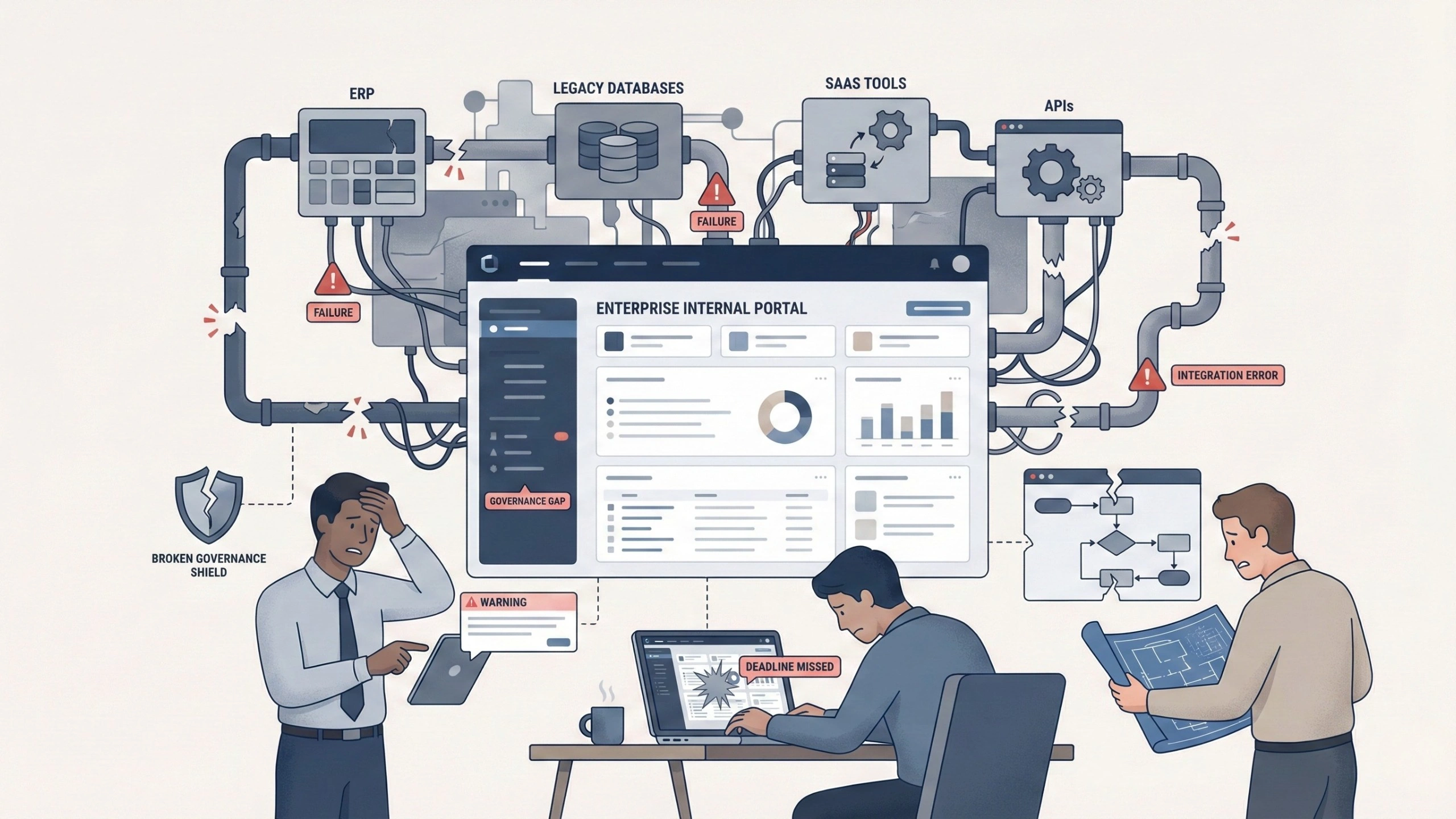
Most large enterprises have at least one failed internal portal project in their history. Sometimes several. These failures are rarely discussed openly, but they follow a familiar pattern: initial enthusiasm, spiraling complexity, missed deadlines, frustrated users, and eventually a quiet shutdown or a permanent state of “we’ll fix it later.”
The problem is not a lack of investment. Companies spend millions on internal portals. They hire experienced vendors, engage consultancies, and staff dedicated project teams. Yet the results remain disappointing.
The reason is straightforward. Enterprise internal portals are deceptively difficult to build well, and most organizations underestimate what it actually takes to succeed.
Why Internal Portals Look Simple But Aren’t
On the surface, an internal portal seems like a reasonable undertaking. You need a central hub where employees can access information, complete tasks, and interact with core business systems. The requirements sound clear. The value proposition is obvious.
But enterprises are not simple environments. A portal that works for 500 people will break at 5,000. A design that handles three departments will collapse under thirty. A system that integrates with five backend applications will become unmanageable when it needs to connect with fifty.
Scale changes everything. And most portal projects fail because they treat scale as a configuration problem rather than a fundamental design challenge.
The Integration Problem Nobody Solves Cleanly
The hardest part of building an enterprise portal is not the portal itself. It is dealing with the decades of accumulated technology that sits behind it.
Large enterprises run on layers of systems built over time. There are ERPs from the 2000s, custom applications from the 2010s, SaaS tools added in the last five years, and legacy databases that predate all of them. Each system has its own authentication model, data structure, API quality, and operational constraints.
A successful portal needs to pull information from all of these systems, present it coherently, and allow employees to take action without forcing them to understand the underlying complexity. This is extraordinarily difficult.
Most vendors approach integration as a technical challenge. They map APIs, build connectors, and declare success once data flows. But integration is not just technical. It is organizational. Different departments own different systems. Each has its own priorities, security requirements, and change management processes. Getting everyone aligned takes longer than building the technology.
The result is predictable. Integration timelines slip. Scope expands. The portal launches with limited functionality, and employees continue using the old systems because the new portal does not actually make their work easier.
The User Experience Trap
Enterprise portals are built by committees. This is unavoidable at scale, but it creates a structural problem. Every department wants their content prioritized. Every stakeholder has opinions about navigation, design, and functionality. The result is a compromise that satisfies no one.
Users do not care about organizational politics. They want to find what they need quickly and complete their tasks without friction. When a portal becomes a dumping ground for every departmental requirement, it stops being useful.
The other problem is that internal users are not patient. They compare enterprise tools to the consumer applications they use every day. If the portal is slow, confusing, or unreliable, they will find workarounds. Adoption rates drop, and the portal becomes a symbolic project rather than a functional tool.
Designing a portal that actually works requires someone to make hard decisions about what to include and what to leave out. In most enterprises, no one has the authority or the willingness to do this. So portals become bloated, slow, and unusable.
Governance and Ownership Failures
Enterprise portals are never “finished.” They require ongoing content management, system updates, security patches, and feature enhancements. This means someone needs to own the portal on a permanent basis, not just during the initial build.
In practice, ownership is almost always unclear. IT builds the infrastructure but does not control the content. HR, operations, and other departments contribute content but have no technical authority. Executive sponsors move on to other priorities once the portal launches. The result is drift. Content becomes outdated. Integrations break. Performance degrades. No one takes responsibility.
Successful portals require clear governance from day one. Someone must own the roadmap, enforce standards, manage integrations, and ensure the portal evolves with the business. Without this, even well-built portals decay over time.
Why Traditional Vendors Struggle
Most enterprise software vendors are set up to sell licenses and implementation services, not to deliver complex, multi-year portal programs. They have standardized processes, offshore delivery teams, and a focus on minimizing their own risk rather than maximizing client outcomes.
This model works for straightforward implementations. It breaks down when projects require deep customization, continuous iteration, and long-term operational ownership. Vendors deliver what is in the contract, but contracts are written before the real complexity is understood. By the time the organization realizes the portal is not meeting expectations, the vendor has moved on.
The other issue is that large vendors operate at scale. They staff projects with junior teams supervised remotely by senior architects. This creates communication gaps, quality issues, and a reliance on documentation over judgment. For a portal that needs to adapt to organizational change, this approach is too rigid.
How Ozrit Approaches Enterprise Portals Differently
Ozrit works with large enterprises on complex internal portal programs, but the delivery model is structured to avoid the common failure patterns.
The first difference is senior team involvement. Ozrit does not delegate enterprise programs to junior offshore teams. Senior architects and delivery leads stay involved throughout the project, not just in the design phase. This ensures that when complexity increases or requirements change, the people making decisions understand the full context.
The second difference is a focus on execution over process. Large portal programs need structure, but they also need flexibility. Ozrit uses a phased delivery model that allows for iteration and adjustment as the organization learns what actually works. This reduces the risk of building the wrong thing and gives stakeholders confidence that the project is progressing toward a functional outcome.
The third difference is onboarding. Ozrit invests significant time upfront understanding the client’s systems, organizational structure, and political landscape. This is not a sales process. It is a technical and operational assessment that identifies integration challenges, governance gaps, and potential roadblocks before they become problems. This reduces surprises and sets realistic expectations.
Ozrit also maintains structured ownership after launch. Portals need ongoing management, and Ozrit provides 24/7 support with clear escalation paths. This is not a help desk answering tickets. It is operational ownership that ensures the portal remains reliable, secure, and aligned with business needs.
Realistic timelines are part of this approach. A large-scale enterprise portal typically takes 12 to 18 months to reach full production maturity. Ozrit does not promise six-month miracles. Instead, the focus is on delivering incremental value at each phase so that the organization sees progress and can course-correct if needed.
What Success Actually Looks Like
A successful enterprise portal is not flashy. It does not win design awards. It is fast, intuitive, and so well-integrated into daily work that employees stop thinking about it.
Success means employees use the portal by default, not because they are forced to. It means integration issues are resolved proactively, not through emergency escalations. It means governance is clear, ownership is respected, and the portal evolves as the business changes.
This kind of success is rare because it requires sustained focus, senior-level involvement, and a willingness to make hard decisions about scope and priorities. It also requires a delivery partner who understands that enterprise technology is as much about people and process as it is about code.
A Final Thought
The enterprises that succeed with internal portals are the ones that treat them as long-term operational assets, not one-time projects. They invest in governance, demand senior-level accountability from their vendors, and accept that shortcuts lead to failure.
If your organization is planning a new portal or trying to salvage an existing one, the most important decision is not which technology platform to use. It is who will own the delivery, how they will handle complexity, and whether they have the experience to navigate the organizational challenges that inevitably arise.