

- Your cart is empty Browse Shop
How Scalable Custom Software Drives Business Growth in 2026?
Introduction
Here’s a scenario that plays out every day in businesses across Hyderabad: A growing company in Gachibowli starts with a simple off-the-shelf software solution. It works fine initially, until the team expands, customer demands evolve, and suddenly, the software that once seemed perfect is now holding everyone back. Sound familiar?
The real question isn’t whether your business needs software; it’s whether you’re investing in software that grows with you or software that you’ll outgrow in 18 months.
In 2026, the difference between businesses that scale smoothly and those that struggle often comes down to one critical decision: choosing scalable custom software over quick-fix, one-off solutions. From the bustling tech corridors of HITEC City to the manufacturing units in Patancheru, forward-thinking companies are realising that custom software isn’t just an IT expense; it’s a growth engine.
But what exactly makes custom software scalable? And why are businesses across Banjara Hills, Jubilee Hills, and beyond ditching their patchwork of generic tools for tailored solutions? Let’s explore how scalable custom software is transforming business growth in 2026 and why the upfront investment pays dividends for years to come.
Understanding the True Cost of One-Off Software Solutions
Walk into any established business in Secunderabad or Madhapur, and you’ll likely find a Frankenstein’s monster of software systems, an accounting tool here, a CRM there, a custom Excel sheet holding it all together with virtual duct tape. This is the hidden cost of one-off solutions that nobody warns you about.
One-off software solutions are designed to solve immediate problems without considering future needs. They’re the business equivalent of patching a leak instead of fixing the plumbing. Sure, you save money today, but the long-term costs are staggering.
Consider a retail chain expanding from one outlet in Ameerpet to multiple locations across Hyderabad. Their point-of-sale system works fine for a single store, but adding locations requires either buying separate licenses for each outlet or completely replacing the system. Neither option is ideal, and both are expensive.
Research shows that businesses using disconnected, one-off solutions spend up to 40% of their IT budget just maintaining and integrating these systems. That’s money not going toward innovation, customer experience, or actual growth. Employees in your Kondapur office waste hours manually transferring data between systems, increasing the risk of errors and killing productivity.
The real cost isn’t just financial; it’s the opportunity cost. While you’re wrestling with software limitations, your competitors using scalable custom software are moving faster, serving customers better, and capturing market share.
Why Scalable Custom Software Is the Foundation of Sustainable Growth
Scalable custom software is built with a fundamental understanding: your business today won’t look like your business tomorrow. And that’s a good thing, because growth is the goal.
Think of scalable custom software as a building with a solid foundation and modular rooms. You can add floors, expand wings, and renovate sections without tearing down the entire structure. This flexibility is what separates businesses that scale smoothly from those that hit painful growth plateaus.
A logistics company operating from Kukatpally perfectly illustrates this principle. They started with custom software managing 50 deliveries daily. As they expanded operations, the same system seamlessly scaled to handle 500, then 5,000 deliveries, without requiring a complete rebuild. New features like route optimisation and real-time tracking were added incrementally, and integrations with new payment gateways and warehouse management systems happened effortlessly.
This is the power of scalable custom software: it adapts to your growth rather than restricting it. When you open a new branch in Kompally or add a new product line, your software evolves with you instead of becoming an obstacle.
The business impact is measurable. Companies using scalable custom software report 3-5 times faster feature deployment, 60% reduction in technical debt, and significantly lower long-term total cost of ownership compared to constantly replacing one-off solutions.
Long-Term Systems Eliminate Integration Nightmares
Here’s a pain point every business leader understands: you have five different software tools, and none of them talk to each other properly. Your sales data lives in one system, inventory in another, and accounting in a third. Generating a simple report requires exporting data from multiple sources, manually combining them, and hoping you didn’t miss anything.
This integration nightmare is the natural consequence of accumulating one-off solutions over time. Each tool was purchased to solve a specific problem, but nobody thought about how they’d work together.
Scalable custom software takes the opposite approach. It’s designed as an integrated ecosystem from day one. Whether your team is in the Financial District handling accounts or in Somajiguda managing operations, everyone works within a unified system that provides real-time, consistent data.
Consider a healthcare provider with clinics across Begumpet and LB Nagar. Their scalable custom software connects patient records, appointment scheduling, billing, inventory management, and compliance reporting in one seamless system. Doctors access patient history instantly, billing happens automatically after consultations, and inventory is reordered when stock runs low, all without manual intervention.
The efficiency gains are remarkable. Businesses report saving 15-20 hours per week per employee when they eliminate manual data entry and integration workarounds. That’s time redirected toward serving customers, innovating, and growing the business.
Moreover, integrated systems reduce errors dramatically. When data flows automatically between modules, the chances of typos, version conflicts, and miscommunication plummet. For businesses in regulated industries, this isn’t just convenient, it’s essential for compliance and risk management.
Competitive Advantage Through Customisation and Flexibility
Off-the-shelf software gives you what everyone else has. Scalable custom software gives you what your competitors wish they had.
In 2026, differentiation isn’t just about your product or service; it’s about how efficiently you deliver it. Custom Software becomes your competitive moat, enabling workflows, features, and customer experiences that generic solutions simply can’t match.
Take an education technology company based in Hitech City. Their scalable custom software includes features specifically designed for the Indian market: multilingual support for regional languages, integration with UPI payment systems, offline-first architecture for areas with spotty connectivity, and culturally relevant content delivery. No off-the-shelf global product offers this level of localisation.
Or consider a manufacturing business in Patancheru with unique production processes. Generic ERP systems force them to adapt their proven workflows to fit the software’s limitations. Scalable custom software does the opposite; it’s built around their processes, preserving the operational advantages that make them successful while adding automation and intelligence.
This flexibility extends to responding to market changes. When regulations change, customer preferences shift, or new opportunities emerge, businesses with scalable custom software can adapt in weeks rather than months. They’re not waiting for a vendor to maybe add a feature in the next version release; they control their own destiny.
The competitive advantage compounds over time. While competitors struggle with the constraints of generic software, companies with scalable custom solutions continuously refine and optimise their operations, pulling further ahead with each iteration.
Future-Proofing Your Business With Modular Architecture
The technology landscape changes rapidly. The software architecture that made sense three years ago might be obsolete today. This is where the modular approach of scalable custom software becomes invaluable.
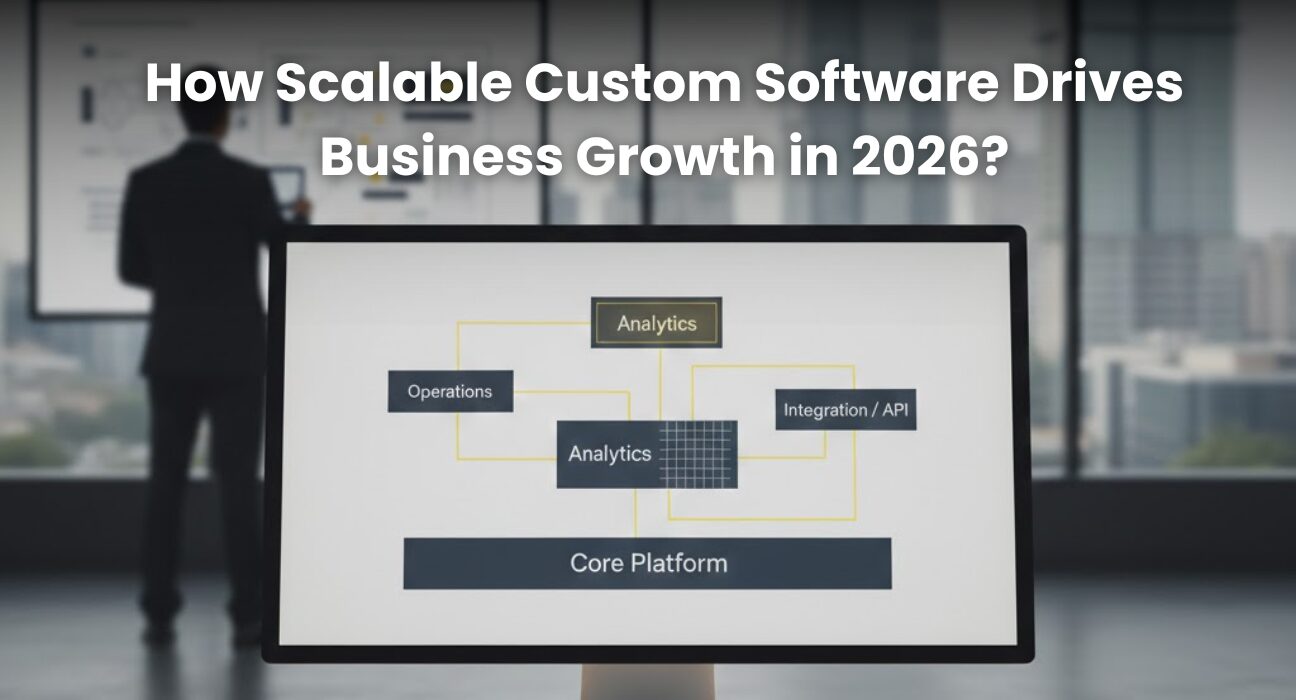
Modular architecture means your software is built as a collection of independent, interconnected components. Each module handles specific functionality and can be updated, replaced, or expanded without disrupting the entire system. It’s like changing the engine in your car without having to rebuild the entire vehicle.
A fintech startup in Banjara Hills exemplifies this approach. Their scalable custom software started with core modules for payments and user management. As they grew, they added modules for lending, investment tracking, and insurance, all without touching the foundation. When a better payment gateway emerged, they swapped modules in days rather than months.
This modularity provides genuine future-proofing. When artificial intelligence becomes essential for your operations, you add an AI module. When you need to integrate with new partners or platforms, you build interface modules. When regulations change, you update compliance modules without disrupting business operations.
For businesses planning long-term growth, modular, scalable custom software eliminates the fear of technological obsolescence. You’re not locked into technology choices made years ago; you can evolve components incrementally while maintaining system stability.
This approach also significantly reduces risk. Traditional system replacements are high-stakes, all-or-nothing gambles. With modular architecture, changes happen incrementally with lower risk and faster time-to-value. If a new module doesn’t work as expected, you can roll back without catastrophic consequences.
Data Ownership and Security in Custom Solutions
Here’s an uncomfortable truth about many off-the-shelf solutions: you don’t really own your data, and you have limited control over its security. You’re trusting a third-party vendor with your most valuable business asset, hoping their security measures are adequate and their business model doesn’t change.
Scalable custom software gives you complete data ownership and control. For businesses handling sensitive information, whether it’s customer data in Jubilee Hills retail stores, patient records in Secunderabad hospitals, or financial information in Gachibowli startups, this control is non-negotiable.
With custom software, you decide where data is stored, how it’s encrypted, who has access, and how long it’s retained. You’re not bound by a vendor’s privacy policy that might change without warning. You’re not worried about your competitor using the same software vendor and potentially accessing insights derived from your data.
In 2026, with increasing cyber threats and stringent data protection regulations, this control is invaluable. A data breach can destroy customer trust and result in crippling penalties. Scalable custom software allows you to implement security measures tailored to your specific risks and compliance requirements.
For businesses operating across multiple locations in Hyderabad, from Madhapur to Kondapur to Kompally, centralised data control through custom software ensures consistent security policies and easier compliance management. You have complete audit trails, granular access controls, and the ability to respond quickly to security incidents.
Real ROI: Calculating the Long-Term Value
Let’s talk numbers, because ultimately, business decisions come down to return on investment.
Yes, scalable custom software typically requires a higher upfront investment compared to off-the-shelf solutions. A business in HITEC City might spend ₹15-50 lakhs on custom software versus ₹2-5 lakhs on generic alternatives. This difference stops many businesses from even considering custom solutions.
But here’s what the calculation misses: total cost of ownership over 5-10 years.
Off-the-shelf software comes with recurring license fees, per-user charges that multiply as you grow, integration costs, customisation limitations requiring workarounds, and eventual replacement costs when you outgrow the system. A ₹5 lakh initial investment easily becomes ₹30-40 lakhs over five years, with painful transitions and lost productivity along the way.
Scalable custom software has higher upfront costs but dramatically lower ongoing expenses. After the initial investment, you’re paying for hosting, maintenance, and incremental enhancements, all of which cost less than recurring licenses. More importantly, you’re not paying replacement costs every few years.
The real ROI comes from business outcomes: 30-50% improvement in operational efficiency, 60-70% reduction in manual processes, faster time-to-market for new products and services, better customer experience leading to higher retention, and the ability to scale revenue without proportionally increasing costs.
A manufacturing business in Patancheru reported that its custom software investment paid for itself within 18 months through reduced errors, faster production cycles, and better inventory management alone. The subsequent years have been pure value creation.
For businesses serious about long-term growth in Hyderabad’s competitive market, scalable custom software isn’t an expense; it’s one of the highest-ROI investments you can make.
FAQ Section
Q1: How long does it take to develop scalable custom software?
Development timelines vary based on complexity, but most scalable custom software projects take 3-9 months from requirements gathering to initial deployment. However, the modular approach means you can start using core functionality earlier while additional features are developed. A business in Gachibowli might launch with essential modules in 3-4 months and continuously add capabilities over time.
Q2: Can small businesses afford scalable custom software?
Absolutely. While custom software requires upfront investment, modern development approaches like MVP (Minimum Viable Product) allow small businesses to start with core functionality and scale gradually. Many Hyderabad-based startups begin with a ₹8-15 lakh investment in foundational custom software that grows with them, which is often more cost-effective than repeatedly replacing off-the-shelf solutions.
Q3: What happens if the company that built my custom software goes out of business?
This is a valid concern, which is why code ownership and documentation are crucial. When working with reputable developers in Hyderabad, ensure you have complete source code access, comprehensive documentation, and knowledge transfer. Your software isn’t dependent on the original developer; other developers can maintain and enhance it. This is a key advantage over proprietary off-the-shelf software, where you’re completely dependent on the vendor.
Q4: How do I know if my business needs custom software or if off-the-shelf is sufficient?
Consider custom software if: you have unique processes that differentiate your business, you’re planning significant growth, you need integration across multiple systems, you handle sensitive data requiring specific security, or you’re spending excessive time working around software limitations. Businesses in competitive Hyderabad markets, especially in tech, healthcare, manufacturing, and finance, typically benefit significantly from scalable custom software.
Q5: What’s the difference between scalable custom software and just customising existing software?
Customising existing software (like adding plugins to standard platforms) has limits; you’re still constrained by the underlying architecture. Scalable custom software is built from the ground up for your needs with architecture designed for growth and change. Think of it as the difference between renovating a rental apartment versus building your own house to specifications.
Conclusion:
The businesses thriving in Hyderabad’s competitive landscape in 2026 share a common thread: they’ve invested in scalable custom software that grows with them rather than patching together one-off solutions that constantly hold them back.
From HITEC City’s tech giants to Secunderabad’s established enterprises, from Banjara Hills’ service providers to Patancheru’s manufacturers, the message is clear: scalable custom software isn’t a luxury for large corporations. It’s a strategic necessity for any business serious about sustainable growth.
The choice between quick-fix one-off solutions and long-term scalable systems is ultimately a choice about your business’s future. Do you want to spend the next five years fighting software limitations, or do you want software that amplifies your growth?
Ready to transform your business with scalable Custom Software? Partner with experienced developers who understand both technology and business growth. Don’t let software constraints limit your potential; invest in systems that grow with your ambitions.
Whether you’re a startup in Madhapur planning your first major software investment or an established business in Jubilee Hills looking to replace patchwork solutions, now is the time to build the technological foundation for your next decade of growth.