
SEO in 2026: Conversational Search & the End of Traditional Keywords
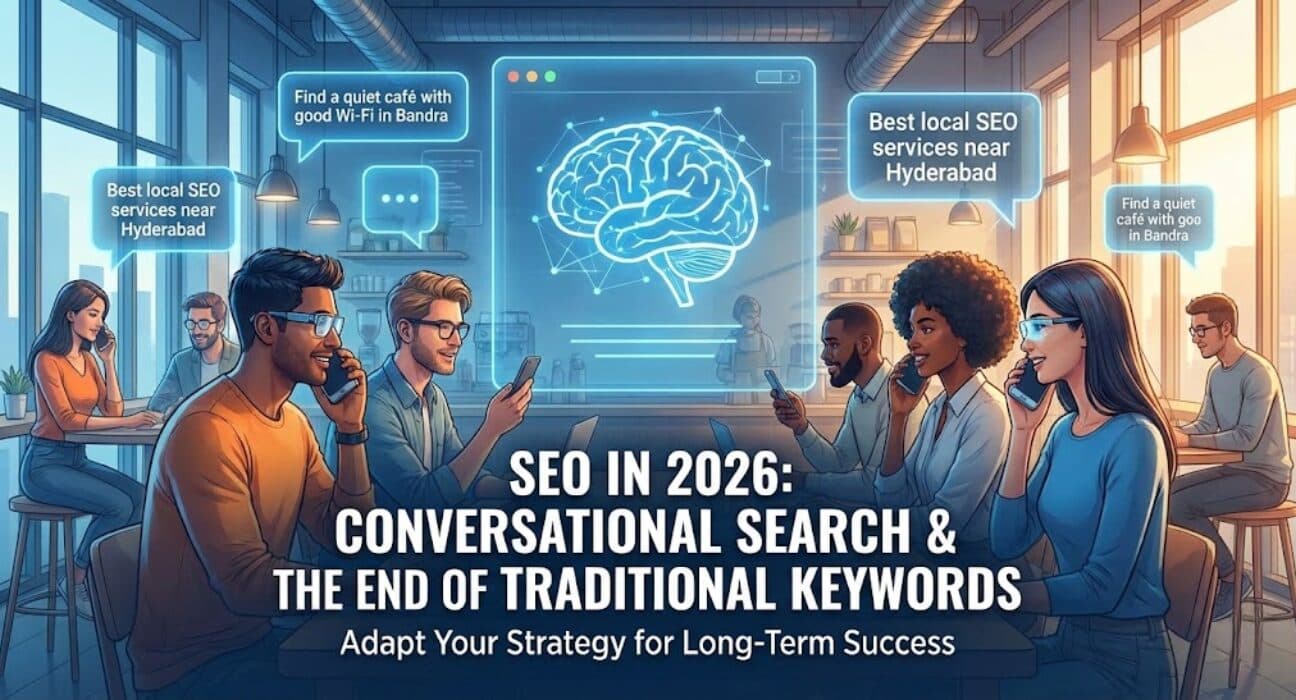
Remember when you used to type “best coffee shop Mumbai” into Google? Today, you’re more likely to ask, “Where can I find a quiet café with good Wi-Fi in Bandra where I can work for a few hours?” This shift isn’t just about convenience; it’s fundamentally changing how businesses need to approach search engine optimisation.
If you’re still stuffing keywords like it’s 2015, you’re already behind. The SEO landscape in 2026 has transformed dramatically, with conversational AI and natural language processing taking centre stage. For businesses in cities like Hyderabad, Bangalore, and Delhi-NCR, understanding this shift isn’t optional anymore, it’s essential for survival in the digital marketplace.
Let’s explore how SEO in 2026 is reshaping the way customers find your business and what you need to do to stay visible in this new era of search.
The Rise of Conversational Search Engines
Conversational search has fundamentally altered how people interact with search engines. According to recent industry data, over 65% of searches now involve natural, question-based queries rather than simple keyword strings. This represents a massive shift from traditional search behaviour.
Think about how your customers in areas like Jubilee Hills, Koramangala, or Connaught Place actually search for services. They’re not typing “plumber Hyderabad” anymore. They’re asking their voice assistants, “Who’s a reliable plumber near me who can fix a leaking bathroom tap today?” or chatting with AI search tools using complete sentences.
This change is powered by advanced large language models that understand context, intent, and nuance. Google’s Search Generative Experience, Bing’s AI integration, and emerging platforms have trained users to search the way they naturally speak. For businesses, this means your old keyword strategy—built around two or three-word phrases, simply won’t cut it anymore.
The implications are profound. Your content needs to answer real questions that real people ask, not just include keywords for the sake of rankings. A restaurant in Indiranagar needs to optimise for questions like “What’s the best place for authentic Hyderabadi biryani with outdoor seating?” rather than just targeting “biryani restaurant Bangalore.”
Understanding User Intent Beyond Simple Keywords
SEO in 2026 demands a deeper understanding of why people search, not just what they search for. Traditional keywords focused on matching words; conversational AI focuses on matching meaning and intent.
Consider a local business in Gachibowli or Whitefield. When someone searches “affordable digital marketing services,” they might actually mean several different things: comparing prices, finding budget options for startups, or looking for payment plans. Conversational search engines analyse the full context, previous searches, location, time of day, and device, to understand the true intent.
This is where long-tail conversational phrases become crucial. Instead of targeting “SEO services,” smart businesses now optimise for questions like:
- “How much should SEO cost for a small business in Hyderabad?”
- “What’s the difference between local SEO and regular SEO for my shop in Madhapur?”
- “Can SEO help my boutique in Banjara Hills get more walk-in customers?”
These longer, more specific queries actually convert better because they capture users further along in their decision-making journey. Someone asking “What should I look for in an SEO company in Secunderabad?” is closer to hiring someone than a person simply searching “SEO company.”
The businesses winning in 2026 create content that naturally addresses these detailed questions. They structure their websites and blog posts to provide clear, direct answers that conversational AI can easily extract and present to users.
Content Strategy for Voice and AI-Powered Search
Voice search has grown exponentially, with studies showing that approximately 50% of all searches now involve voice commands on mobile devices. In India, where multilingual voice search is particularly popular, this trend is even more pronounced across cities like Chennai, Pune, and Kolkata.
Your content strategy must adapt to how people actually speak. When typing, someone might search “dentist teeth whitening cost.” When speaking, they ask, “How much does teeth whitening cost at a dentist near Hitech City?”
Here’s what works for voice and AI-powered search in 2026:
Featured snippet optimisation: Structure your content to directly answer common questions. Use clear headings phrased as questions, followed by concise answers of 40-60 words. For example, if you run a fitness centre in Kondapur, create sections like “What are the membership fees?” or “What classes do you offer for beginners?”
Natural language patterns: Write the way people speak. Include conversational phrases, local references, and colloquial terms. A café in Jubilee Hills might mention “right next to KBR Park” or “opposite the Apollo Hospital” because that’s how locals give directions.
FAQ sections: Every service page needs a comprehensive FAQ section. These directly feed into conversational AI responses. A real estate agency in Kukatpally should answer questions like “What’s the average price per square foot?” or “Which neighbourhoods are best for young families?”
Local context: Integrate neighbourhood-specific information naturally. Mention landmarks, nearby Metro stations, popular shopping areas, and local events. This helps conversational search engines understand your geographical relevance.
Semantic Search and Topic Clusters
SEO in 2026 isn’t about individual keywords anymore, it’s about comprehensive topic coverage. Search engines now evaluate your entire site’s authority on a subject, not just how well a single page ranks for a specific term.
This is where topic clusters come in. Instead of creating isolated blog posts targeting different keywords, you build content hubs around core topics. A digital marketing agency might create a pillar page about “Complete Guide to Online Marketing for Local Businesses” and link it to cluster content covering social media marketing, email campaigns, search optimisation, and content creation.
Semantic search understands relationships between concepts. It knows that “SEO” relates to “search rankings,” “website traffic,” “keyword research,” and “content optimisation.” When you thoroughly cover related topics, search engines recognise your expertise and authority.
For a local business in areas like Ameerpet, Begumpet, or Miyapur, this means creating content that addresses all aspects of your service. A home renovation company shouldn’t just write about “interior design”, they should cover budgeting, material selection, timeline planning, contractor selection, and neighbourhood-specific regulations.
Internal linking between related content pieces signals to search engines how your topics connect. This creates a knowledge web that conversational AI can navigate to provide comprehensive answers to user queries.
The Technical Side: Structured Data and Schema Markup
While content is crucial, technical SEO remains the foundation that makes everything work. In 2026, structured data and schema markup are non-negotiable for appearing in AI-generated responses.
Schema markup is code that helps search engines understand your content’s context. It tells them, “This is a product,” “This is a review,” “This is a local business,” or “This is an event.” When conversational AI tries to answer user questions, it prioritises websites with clear, structured information.
For businesses in Hyderabad and surrounding areas, the local business schema is particularly important. This includes your NAP (Name, Address, Phone number), operating hours, service areas, accepted payment methods, and customer reviews. When someone in LB Nagar asks, “Which salons are open on Sunday evening?” conversational search pulls from this structured data.
FAQ schema allows you to mark up question-and-answer pairs on your website, making them eligible for direct display in search results. Review schema helps showcase your ratings. Product schema provides pricing and availability information. Event schema promotes your workshops or sales.
Implementation might seem technical, but numerous tools and plugins simplify the process. The investment is worth it, websites with proper schema markup see significantly higher visibility in AI-powered search results compared to those without.
Mobile-First and Speed Optimisation
Conversational search overwhelmingly happens on mobile devices. In India, where mobile internet usage far exceeds desktop usage, this is particularly critical. A slow-loading website won’t just hurt your rankings; it won’t even get considered by conversational AI when answering user queries.
Page speed has become a crucial ranking factor. Google’s Core Web Vitals measure how quickly your content loads, how stable it is while loading, and how responsive it is to user interaction. Websites that score poorly on these metrics struggle to appear in search results, especially for mobile users in areas with varying connectivity, like the outskirts of cities, including Shamshabad or Patancheru.
Mobile optimisation goes beyond responsive design. Your site must be genuinely usable on small screens. Buttons need to be thumb-friendly, text must be readable without zooming, forms should be simple to complete, and navigation should work with one hand.
For local businesses, click-to-call functionality is essential. When someone finds your business through conversational search on their phone, they should be able to call you immediately with one tap. Similarly, integrated maps for directions and mobile-friendly contact forms reduce friction in the customer journey.
Image optimisation, clean code, efficient hosting, and content delivery networks all contribute to faster loading times. Every second of delay costs you potential customers; research shows that 40% of users abandon websites that take more than three seconds to load.
Measuring Success in the Conversational Search Era
Traditional SEO metrics still matter, but SEO in 2026 requires new ways of measuring success. Keyword rankings, while relevant, don’t tell the complete story anymore.
Focus on these metrics:
Zero-click searches: Many conversational queries are answered directly in search results without requiring a click. Track how often your content appears in these AI-generated answers, even if users don’t visit your site. Brand visibility still has value.
Featured snippet ownership: Monitor which questions your content answers in position zero. These prime spots receive significant visibility in voice search results.
User engagement signals: Time on site, pages per session, and bounce rate indicate whether your content truly satisfies user intent. Conversational AI considers these when determining content quality.
Conversion rate from organic search: Ultimately, SEO success means business growth. Track how many conversions (sales, leads, calls, bookings) come from organic search compared to other channels.
Local visibility metrics: For businesses serving specific areas like Madhapur, Hitec City, or Gachibowli, track local pack rankings, “near me” search appearances, and Google Business Profile insights.
Use tools like Google Analytics 4, Google Search Console, and specialised SEO platforms to monitor these metrics. Regular analysis helps you understand what’s working and where to adjust your strategy.
Conclusion:
SEO in 2026 isn’t about gaming algorithms or stuffing keywords; it’s about genuinely helping your customers find the answers they need. Conversational search has made the internet more intuitive and user-friendly, and businesses that embrace this change will thrive.
The shift toward natural language, AI-powered responses, and intent-based search means your content must be more helpful, more comprehensive, and more authentic than ever before. Whether you’re a small shop in Secunderabad or a growing enterprise in Hitech City, your digital presence needs to reflect how real people actually search and communicate.
Start by auditing your current content through the lens of conversational search. Are you answering real questions? Is your technical foundation solid? Have you structured your information for AI readability? Are you providing genuine value to your local community in areas like Kukatpally, Miyapur, or Ameerpet?
The businesses winning in this new era aren’t necessarily the biggest; they’re the ones that best understand their customers’ needs and communicate in ways that resonate with both humans and AI.
If you’re feeling overwhelmed by these changes or need expert guidance to navigate the evolving world of SEO in 2026, Ozrit specialises in helping businesses adapt their digital strategies for conversational search and modern SEO practices. The future of search is here, and with the right approach, your business can not just survive but thrive in this exciting new landscape.