
Why Most Enterprise Digital Transformations Fail After Vendor Selection
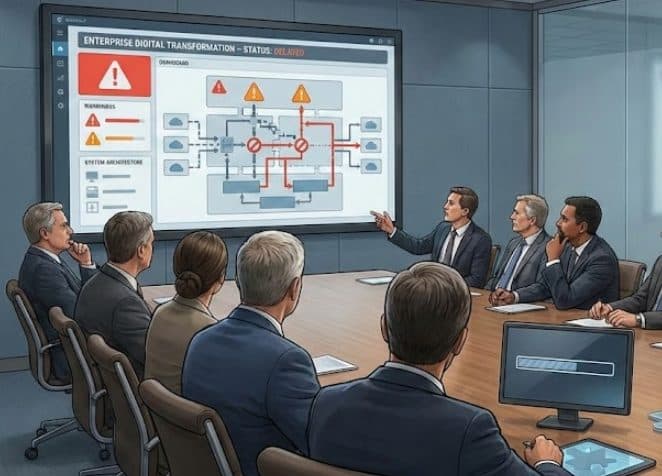
The vendor has been chosen. The business case is approved. Budgets are allocated, and everyone agrees on the strategic value of the program. Yet within months, the initiative is struggling. Timelines slip. Scope becomes unclear. Communication between the vendor and internal teams grows strained. By the time leadership intervenes, the program has burned through budget and credibility.
This pattern repeats across enterprises of every size and industry. The failure point isn’t the technology or the initial strategy. It’s what happens in the gap between signing the contract and delivering real capability. Understanding why this gap exists, and how to close it, is essential for any executive sponsoring a major transformation.
Why Enterprise Execution Is Different
Digital transformation at enterprise scale involves challenges that don’t exist in smaller organizations. Legacy systems built over decades must continue running while new capabilities are integrated. Data sits across multiple platforms, often with conflicting definitions of basic terms. Governance structures require approvals from stakeholders across regions, divisions, and functions, each with legitimate concerns about risk and operational continuity.
The technical work itself is often manageable. What breaks most programs is organizational complexity. Vendors who’ve primarily worked with mid-market companies or sold products to general audiences lack the experience to navigate this environment. They underestimate how long decisions take, how many people need to be involved, and how carefully changes must be managed when thousands of employees depend on systems working exactly as they do today.
This isn’t about bureaucracy or resistance to change. It’s about the reality of running large, complex operations where mistakes have serious consequences. Vendors who don’t understand this deliver proposals with aggressive timelines and confident promises that fall apart on contact with actual enterprise constraints.
Where Vendors Lose the Thread
Most vendor relationships start well. Senior people show up for sales meetings, demonstrate deep understanding of the problem, and outline compelling solutions. Once the contract is signed, a different pattern emerges. Delivery gets handed to less experienced teams. The people making day-to-day decisions haven’t held operational responsibility or managed programs at this scale before.
Communication becomes the first casualty. Status meetings focus on activity rather than progress. Issues get surfaced late, when they’ve already become expensive to fix. Questions require escalation to someone outside the delivery team, which adds delay and breaks continuity. The vendor’s project manager lacks authority to make real decisions, so everything moves slower than it should.
Large system integrators present their own problems. They staff projects based on availability rather than fit. Utilization rates drive resource decisions more than program needs. Their economic model benefits from extended timelines and expanded scope, creating incentives that don’t align with the client’s interest in fast, focused delivery.
The fundamental issue is accountability. Traditional vendors get paid whether the transformation succeeds or fails. They can walk away from struggling programs with the enterprise’s logo on their website regardless of actual outcomes. The enterprise bears all the real risk: operational disruption, wasted investment, damaged credibility with internal stakeholders, and lost competitive ground while the program drags on.
How Ozrit Structures Enterprise Delivery
Ozrit’s model addresses these problems through team structure and ownership clarity. The people who engage during the sales process are the same people who lead delivery. There’s no handoff to junior resources learning on the client’s budget. The expertise promised is the expertise provided.
Team composition matters more than team size. Ozrit maintains deliberately senior staffing, with professionals who’ve led complex enterprise programs before. These aren’t recent graduates or mid-level consultants. They’re people who understand how large organizations work, who can navigate stakeholder complexity, and who have the judgment to make good decisions under pressure. This allows faster progress with smaller teams because the people involved have the experience to work efficiently.
Ownership is clear from the start. Specific individuals are accountable for specific outcomes, with their names and reputations attached to the work. When problems arise, and they always do in complex transformations, decisions get made quickly because the people in the room have authority to make them. There’s no bureaucratic chain slowing everything down.
This structure changes how work gets done. Status conversations focus on actual progress and real issues rather than carefully managed messaging. When something isn’t working, the team shifts immediately to solving it rather than documenting why it’s not their responsibility. This matters enormously in enterprise programs where momentum is hard to build and easy to lose.
Discovery That Reflects Reality
The discovery phase determines everything that follows, yet most vendors rush through it to reach billable implementation work. Ozrit takes the opposite approach. The first weeks focus entirely on understanding what’s actually true about the client’s environment, not what’s written in outdated documentation or assumed from similar projects elsewhere.
This means talking to the people who run systems daily, not just executives who sponsor the program. It means examining actual code, actual data flows, actual integration points. It means identifying dependencies that aren’t documented, constraints that weren’t mentioned in early conversations, and risks that everyone assumed someone else was managing.
From this foundation, planning becomes realistic. Timelines account for governance cycles, approval processes, and the actual pace at which large organizations can absorb change. Milestones are structured around delivering working capability that can be tested and validated, not completing phases in a methodology framework.
Execution follows a rhythm that enterprise teams recognize as credible. Regular checkpoints ensure alignment without creating meeting overhead. Technical decisions get made with an understanding of long-term operational implications, not just what’s fastest to implement right now. Issues surface early when they’re still manageable rather than late when they threaten the entire program.
Technology With Purpose
AI and automation have genuine applications in enterprise transformation, but only when applied to real problems. Ozrit uses these technologies where they create measurable value: accelerating testing cycles, identifying integration issues before production deployment, automating configuration work that would otherwise consume weeks of manual effort.
This practical approach extends to all technology choices. The goal isn’t using the newest framework or following architectural trends. It’s delivering capabilities that work reliably at scale, that internal teams can support after the engagement ends, that integrate cleanly with existing systems, and that solve actual business problems rather than creating impressive demonstrations.
Modern tooling enables faster delivery and higher quality, but only when used by people who understand the difference between a proof of concept and something that must run in production for years. That judgment comes from experience, not enthusiasm for new technology.
Support That Continues After Launch
Digital transformation doesn’t end when systems go live. That’s often when the most critical period begins, as the solution encounters actual load, real users, and edge cases that never appeared during testing.
Ozrit provides 24/7 support as a genuine operational capability, not a contract checkbox. The people providing support are the same people who built the system. They understand the architecture, the decisions made during implementation, the tradeoffs accepted, and what monitoring signals matter. There’s no knowledge transfer gap between reporting an issue and getting it diagnosed and fixed.
This continuity matters during the months after launch when systems are most fragile and organizational confidence is being established. Response isn’t measured in ticket queues and SLA calculations. It’s measured in how quickly someone who knows your specific environment can resolve problems.
Long-term partnership means Ozrit’s incentives stay aligned with yours after go-live. If something breaks, it affects their reputation, not just your operations. If the transformation doesn’t deliver promised value, that’s a shared failure, not someone else’s problem to walk away from.
Why Structure Determines Outcomes
Enterprises choose Ozrit over traditional alternatives because the value is straightforward: better results, faster delivery, lower risk. Not through secret methodology or magic process, but through different team composition and incentive structure.
Large integrators bring methodologies and partnership logos. Boutique firms offer senior attention but lack capacity for enterprise scale. Ozrit provides senior expertise without bureaucracy, enterprise capability without bloated structure, and accountability that extends beyond contract signatures to actual operational outcomes.
The best transformations don’t announce themselves with dramatic launches. They manifest as systems that work reliably, capabilities that get adopted because they’re genuinely useful, and initiatives that deliver value within expected timelines. Success means your internal team understands how the system works because they were involved throughout. It means stakeholders who were initially skeptical become advocates because they saw commitments kept consistently.
Enterprise digital transformation fails after vendor selection when organizations choose partners based on presentations rather than delivery structure, on promises rather than team composition, on who shows up for sales meetings rather than who does the actual work. Getting this right requires looking past vendor theater to understand how delivery actually happens. That’s where the difference lives, and that’s what determines whether transformation programs succeed or become expensive lessons in what not to do next time.