
Best Beverage Manufacturing ERP Software: A Buyer’s Guide
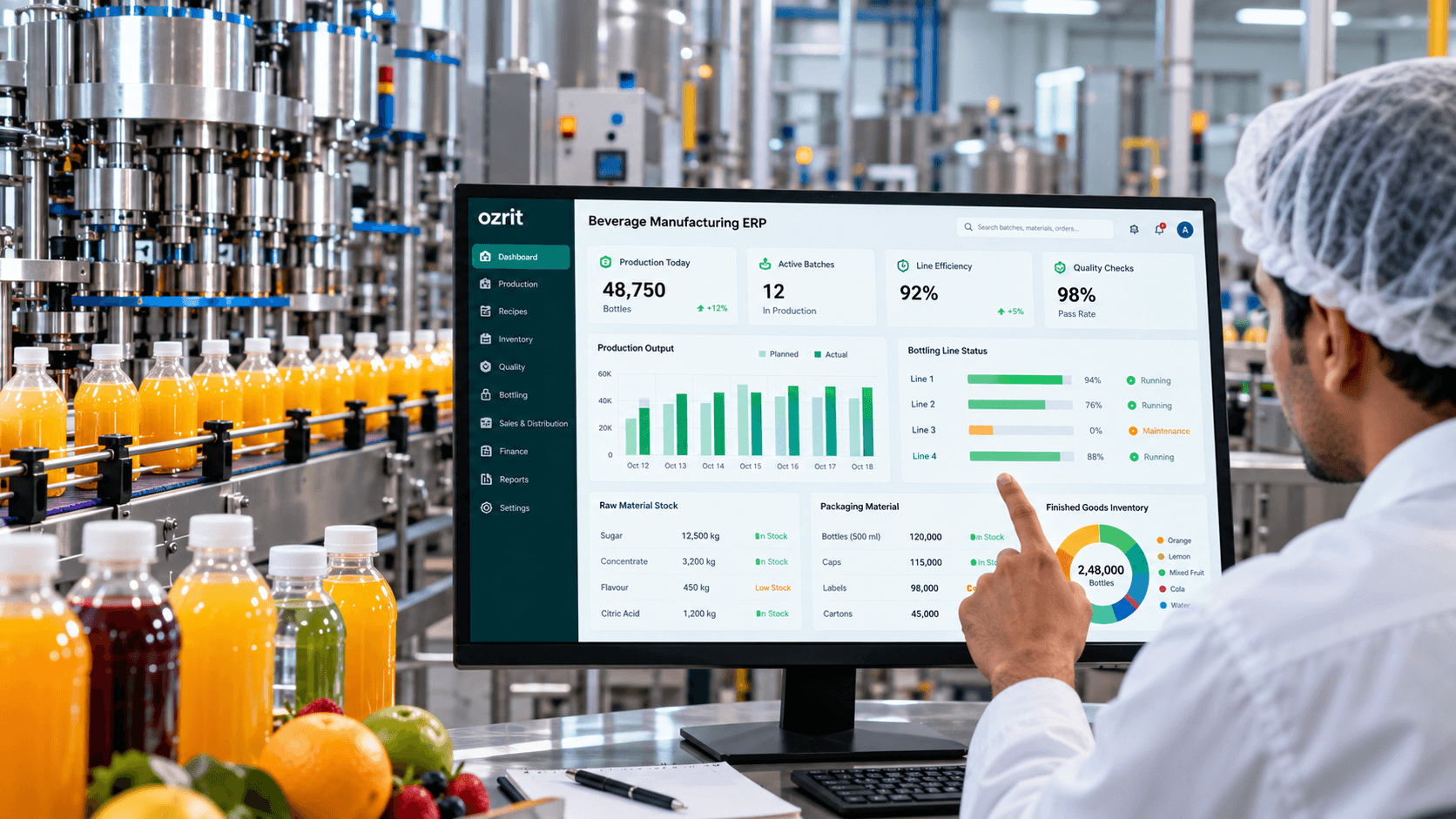
Beverage manufacturing involves much more than producing drinks and packing them into bottles or cans. Manufacturers must manage ingredients, formulations, production schedules, filling lines, packaging materials, quality checks, inventory, distribution and financial records.
When these operations run on disconnected spreadsheets and separate software systems, keeping everything accurate becomes difficult. Production teams may struggle to confirm ingredient availability, warehouse staff may have limited visibility into expiry dates, and management may not have a clear picture of manufacturing costs.
This is where beverage manufacturing ERP software can help.
A well-planned ERP system connects important business processes, helping beverage manufacturers manage operations with better visibility and consistency. However, choosing the right software requires more than comparing feature lists.
This guide explains the essential features of beverage manufacturing ERP software, what to consider when evaluating vendors and how to choose an approach that suits your business.
What Is Beverage Manufacturing ERP Software?
Beverage manufacturing ERP software is an enterprise resource planning system designed to manage the business processes involved in producing and distributing beverages.
Depending on the solution and implementation scope, it can connect:
- Raw material procurement and inventory.
- Recipe and formulation management.
- Production planning and scheduling.
- Batch and lot tracking.
- Quality inspections.
- Bottling and packaging operations.
- Finished-goods inventory.
- Sales and distribution.
- Finance and production costing.
- Management reporting.
For example, when a juice manufacturer schedules a production batch, the ERP may help check ingredient availability, reserve packaging materials, record actual consumption, track quality results and update finished-goods inventory.
The objective is to reduce disconnected records and give different departments access to consistent operational information.
Why Beverage Manufacturers Need ERP Software
1. Managing recipes and formulations
Beverage manufacturers often work with specific ingredient ratios, formulation versions and production quantities.
A change in a formulation can affect ingredient requirements, production costs, product characteristics and quality checks.
ERP software can maintain approved recipe versions, calculate planned material requirements and record actual ingredient consumption. Access controls and approval workflows can help ensure that production teams use the correct formulation.
2. Coordinating production and bottling
Beverage production involves several connected activities, including ingredient preparation, processing, filling, capping, labelling and packaging.
If these activities are planned separately, production delays and material shortages can become difficult to identify.
An ERP system can help coordinate production orders, material availability, packaging requirements and finished-goods output. Where suitable integrations are available, it may also exchange data with production equipment or manufacturing systems.
3. Controlling inventory and expiry dates
Beverage manufacturers handle ingredients, concentrates, additives, bottles, cans, caps, labels, cartons and finished products.
Each category has different storage, consumption and replenishment requirements.
An ERP can provide warehouse-wise stock visibility, batch-level records, expiry monitoring and reorder alerts. It can also support First Expired, First Out (FEFO) stock allocation where applicable.
This helps warehouse teams make better stock decisions and reduces reliance on manually maintained spreadsheets.
4. Improving batch traceability
Manufacturers need to know which raw materials went into a particular production batch and where the resulting products were dispatched.
A suitable ERP can connect supplier lots, material consumption, production batches, quality records, finished products and dispatch transactions.
These relationships can support investigations and recall exercises. Their reliability depends on accurate data capture and consistent operational procedures.
5. Understanding production costs
The cost of a beverage includes more than its main ingredients.
Depending on the manufacturing process, it may also include packaging materials, labour, energy, processing costs, production losses and allocated overheads.
ERP software can help combine these records to calculate production costs using the methods configured for the business.
Comparing planned costs with actual consumption can also help managers investigate wastage, unusual material usage and production variances.
Essential Features to Look for in Beverage Manufacturing ERP Software
Not every manufacturer needs the same modules. Evaluate each feature against your products, production methods and business requirements.
1. Recipe and formulation management
Look for capabilities such as:
- Ingredient specifications and quantities.
- Recipe version control.
- Formulation approval workflows.
- Batch-size calculations.
- Planned versus actual consumption.
- Ingredient cost calculations.
- Controlled access to formulation changes.
These features are particularly useful when a manufacturer produces multiple beverage variants or frequently updates formulations.
2. Production planning and scheduling
Production planning features should help manufacturers organise orders, resources and materials before production begins.
Useful capabilities include:
- Production order creation.
- Production scheduling.
- Ingredient and packaging availability checks.
- Batch-size planning.
- Planned versus actual output.
- Production status tracking.
- Yield and wastage recording.
- Coordination between processing and packaging.
For example, if a production order requires a particular concentrate and packaging format, the system should help planners check whether the required materials are available before scheduling the run.
3. Raw material and packaging inventory
Inventory management should cover both ingredients and packaging materials.
Look for:
- Warehouse and location-wise stock.
- Batch and lot identification.
- Manufacturing and expiry dates where relevant.
- Stock reservations for production.
- Reorder levels.
- Material issue and return records.
- FEFO allocation where applicable.
- Stock adjustment approvals.
Packaging inventory deserves particular attention because a shortage of caps, labels or cartons can interrupt production even when all ingredients are available.
4. Quality management
Quality workflows vary across beverage categories, so the system should be configurable to the manufacturer’s requirements.
Depending on the process, features may include:
- Incoming material inspections.
- In-process checks.
- Finished-product inspections.
- Recorded test results.
- Acceptance criteria.
- Non-conformance records.
- Corrective action workflows.
- Quality release status.
- Laboratory-system integrations where feasible.
ERP software can help maintain quality records, but product safety and regulatory compliance also depend on validated procedures, appropriate testing and effective operational controls.
5. Batch and lot traceability
Traceability is an important consideration for beverage manufacturers.
Check whether the software can link:
- Suppliers and incoming material lots.
- Ingredients consumed in production.
- Production orders and batch numbers.
- Manufacturing and expiry dates.
- Quality inspection results.
- Finished-goods storage locations.
- Customer orders and dispatches.
Ask the vendor to demonstrate a practical scenario: select a finished-product batch and trace it back to its input materials, then identify the dispatch records associated with that batch.
This is more useful than simply confirming that the software has a feature labelled “batch tracking”.
6. Bottling and packaging management
For bottling plants, production visibility should extend beyond the processing stage.
Depending on the requirements, the ERP may manage:
- Filling and packaging orders.
- Bottle, can and carton consumption.
- Cap and label inventory.
- Packaging batch records.
- Planned versus actual output.
- Rejects and recorded wastage.
- Line stoppages.
- Packaging material reconciliation.
- Finished-product transfers to the warehouse.
If real-time equipment data is required, confirm the availability of interfaces and the technical feasibility of integration with filling machines, PLC/SCADA systems or other industrial equipment.
7. Sales and distribution management
Beverage manufacturers may supply distributors, wholesalers, retailers, institutional customers or direct consumers.
An ERP can help connect customer orders with finished-goods availability, warehouse allocation and dispatch planning.
Relevant capabilities include:
- Customer and distributor records.
- Sales orders.
- Available-to-promise stock, where supported.
- Warehouse allocation.
- Dispatch documentation.
- Returns and damaged stock.
- Sales reporting.
- Integration with CRM or logistics applications.
For businesses operating across several warehouses, accurate stock visibility can help sales and dispatch teams coordinate orders more effectively.
8. Finance and production costing
Finance integration helps connect purchasing, inventory, production and sales records.
Evaluate whether the system supports your requirements for:
- Purchase and sales transactions.
- Inventory valuation.
- Production batch costing.
- Material and packaging costs.
- Cost centres.
- Financial reporting.
- GST-related accounting workflows in India.
- Integration with existing accounting software.
Confirm the specific accounting and costing methods supported rather than assuming all requirements are available by default.
9. Management dashboards and reports
Useful reports help managers understand what is happening across the factory and supply chain.
Depending on the system, dashboards may include:
- Production output by line.
- Planned versus actual production.
- Recorded material wastage.
- Batch yield.
- Inventory availability.
- Near-expiry stock.
- Quality rejection rates.
- Packaging consumption.
- Order fulfilment status.
- Production cost per unit.
Dashboards should be based on reliable source data, clearly defined calculations and appropriate access permissions.
How to Choose the Right Beverage ERP Software
Understand your current problems first
Before evaluating vendors, document the main operational problems.
Are production schedules difficult to coordinate? Are stock records inaccurate? Do you lack batch traceability? Is packaging inventory frequently unavailable when needed?
Prioritise the issues that have the greatest operational impact. This creates a practical basis for comparing solutions.
Map your manufacturing workflow
Document the process from raw material receipt to finished-product dispatch.
For example:
Procurement → Material Inspection → Storage → Production Planning → Processing → Filling and Packaging → Quality Release → Finished-Goods Storage → Dispatch
Your actual workflow may differ based on the beverage category and manufacturing process.
Use this map during demonstrations to check whether the proposed system can support your operations.
Evaluate integration requirements
List your existing accounting software, weighing equipment, barcode scanners, laboratory systems, warehouse tools and production machinery.
Ask which integrations are available, what additional development may be required and how integration failures will be monitored.
Do not assume that every device or third-party application can be connected without additional work.
Compare the total cost of ownership
Software cost is only one part of an ERP investment.
Consider:
- Software licensing or subscription fees.
- Implementation and configuration.
- Custom development.
- Data migration.
- Third-party integrations.
- Infrastructure and hosting.
- User training.
- Support and maintenance.
- Future enhancements.
Compare the expected cost over several years, not just the initial quotation.
Test the software using realistic scenarios
Ask shortlisted vendors to demonstrate your actual workflows with representative sample data.
Test situations such as a rejected ingredient lot, a formulation change, a packaging material shortage, an expiry-related stock restriction and a batch traceability enquiry.
A practical demonstration reveals more than a presentation focused only on standard features.
Custom ERP vs Ready-Made ERP for Beverage Manufacturing
A ready-made ERP may be appropriate when its standard functionality already covers most of your requirements and can be configured without excessive complexity.
A custom ERP may be worth evaluating when your production workflows, equipment integrations or operational rules require specialised functionality.
| Evaluation area | Ready-made ERP | Custom ERP |
|---|---|---|
| Standard features | Often available out of the box, depending on the product | Developed or integrated according to scope |
| Workflow flexibility | Depends on configuration and extension options | Can be designed around defined business requirements |
| Initial implementation | Depends on product and configuration | Depends on development scope and complexity |
| Maintenance | Vendor and implementation-partner arrangements apply | Requires an agreed maintenance and support approach |
| Integrations | Depends on available connectors and APIs | Can be developed where technically feasible |
| Vendor dependency | Depends on the product and contract | Depends on code ownership, documentation and maintainability |
Neither approach is automatically better or cheaper.
For example, a small beverage producer with standard workflows may find an established ERP suitable. A manufacturer with specialised formulation logic and unusual equipment integrations may benefit from evaluating a custom approach.
The decision should follow a requirements assessment rather than a preference for one technology model.
What Does Beverage Manufacturing ERP Software Cost?
There is no single price that applies to every beverage manufacturer.
Cost depends on the number of modules, manufacturing locations, users, integrations, migration requirements, reporting complexity and degree of customisation.
A project covering inventory, purchasing and basic production records will have a different scope from a multi-factory implementation with equipment integrations, detailed costing, traceability and advanced reporting.
Request a breakdown of implementation costs, recurring fees, third-party expenses, support and future enhancements. This makes it easier to compare proposals on a like-for-like basis.
Common Mistakes to Avoid When Selecting Beverage ERP
Choosing based only on price
A low initial quotation may exclude important integrations, migration activities, training or maintenance.
Evaluate the complete scope and expected long-term cost.
Ignoring packaging operations
A system that manages ingredients but overlooks caps, labels, cartons and filling operations may leave important production gaps.
Evaluate the entire workflow, including packaging and finished-goods transfer.
Overlooking data quality
ERP implementation cannot automatically correct every inaccurate supplier record, stock balance or batch reference.
Plan data cleaning, reconciliation and validation before go-live.
Expecting every feature to be available immediately
Some capabilities may require configuration, additional modules or custom development.
Ask the vendor to identify standard functionality, optional features and items that require separate implementation.
Failing to involve factory employees
Production supervisors, warehouse staff, quality teams and finance users understand different aspects of daily operations.
Include them in requirements gathering, demonstrations, testing and training.
How Ozrit Helps With Beverage Manufacturing ERP
Ozrit works with businesses to plan and develop software around their operational requirements.
For beverage manufacturers, a custom ERP project may include recipe and formulation management, production planning, inventory, quality workflows, batch traceability, bottling and packaging records, finance integration and management dashboards.
The appropriate scope depends on the manufacturer’s products, processes, existing systems and priorities.
A typical engagement begins with understanding the current workflow, identifying system gaps and defining the essential modules. From there, the implementation plan can address architecture, development, integration, testing, data migration and user training as agreed.
If you are evaluating ERP options for your manufacturing business, explore Beverage Manufacturing ERP Software services.
Frequently Asked Questions
What is the best ERP software for beverage manufacturing?
The best solution depends on your beverage category, production processes, budget, integrations and reporting needs. Compare suitable ERP products and custom development options against documented business requirements.
Can beverage ERP software manage recipes and formulations?
Yes. Depending on the solution, it can maintain formulation versions, calculate ingredient requirements, record actual consumption and support approval workflows.
Can ERP software track beverage batches and expiry dates?
Many ERP solutions can manage batch identifiers, expiry information and inventory movements. Confirm that the system can link raw materials, production batches, finished products and dispatch records in the way your business requires.
Can beverage ERP integrate with bottling machines?
Integration may be possible through supported APIs, industrial protocols, middleware or other available interfaces. Feasibility depends on the specific equipment, its communication capabilities and the required data exchange.
Is custom ERP suitable for a small beverage manufacturer?
It can be suitable when specialised workflows justify the investment and ongoing maintenance. A smaller manufacturer should also evaluate ready-made ERP products that may already meet its requirements.
Does beverage manufacturing ERP guarantee regulatory compliance?
No. ERP software can help maintain records, support traceability and organise workflows, but compliance depends on the applicable requirements, correct configuration, reliable data and operational practices.
How long does beverage ERP implementation take?
The timeline depends on the scope, integrations, data readiness, testing requirements and number of locations. A realistic schedule should be established after the requirements are assessed.
Conclusion
Choosing the best beverage manufacturing ERP software starts with understanding how your factory operates.
Evaluate recipe management, production planning, inventory, quality, batch traceability, bottling, distribution and costing against your actual requirements. Then compare the available solutions, integrations, implementation scope and total cost of ownership.
The right ERP should support your current operations while providing a practical path for future growth.
If you are planning a new system or modernising existing software, explore Beverage Manufacturing ERP Software to discuss your requirements.