
Beverage Inventory Management and Batch Traceability: A Practical Guide
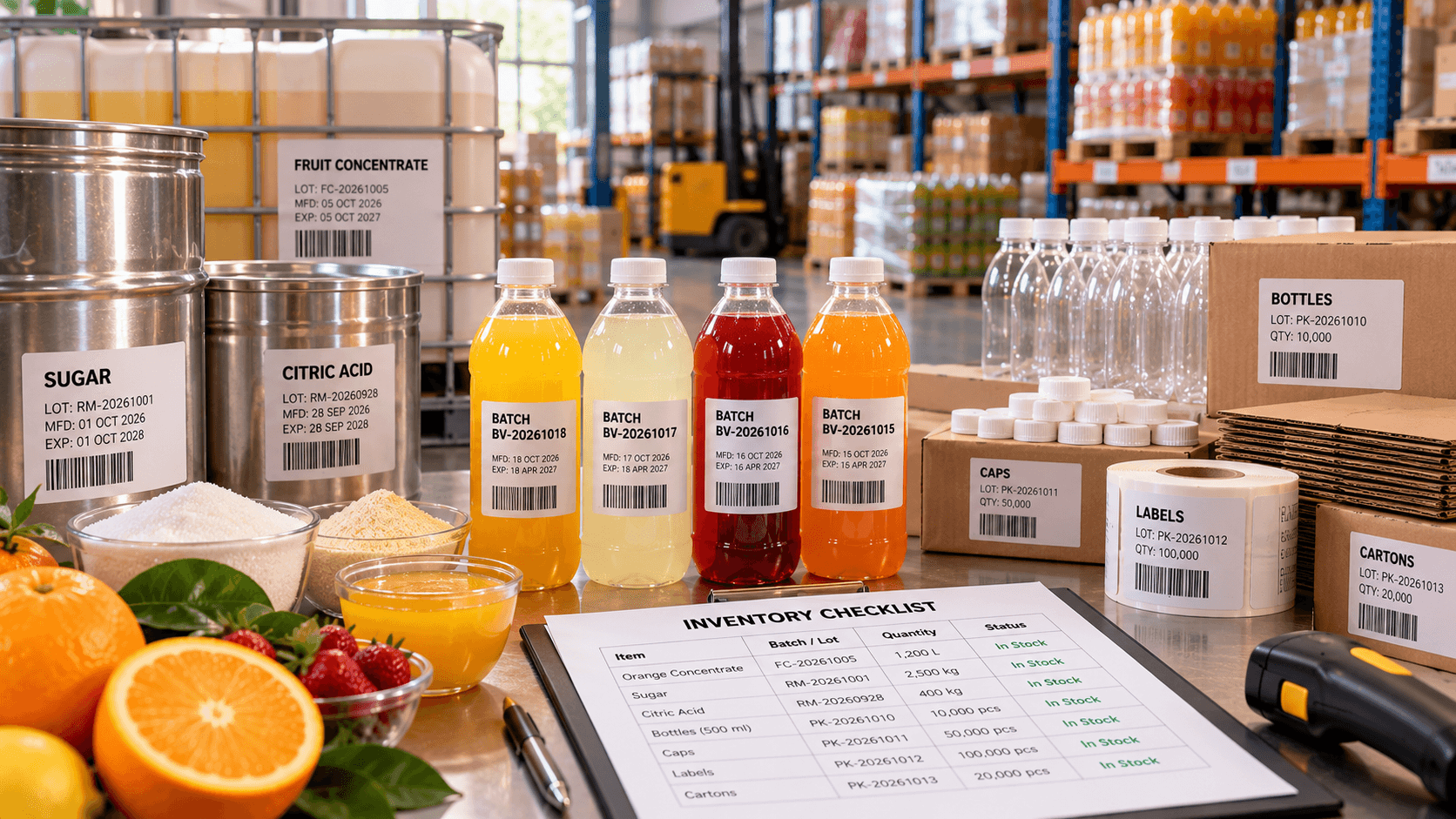
Beverage manufacturers handle a wide range of inventory, from ingredients and concentrates to bottles, caps, labels, cartons and finished products. Managing these materials becomes more challenging when products have different shelf lives, multiple packaging formats and strict quality requirements.
Without accurate inventory records, manufacturers may face material shortages, excess stock, expired ingredients, production delays and difficulties tracing affected products when a quality issue occurs.
Beverage inventory management software helps businesses track materials, monitor stock movements, manage expiry dates and connect inventory records with production and distribution. When combined with batch traceability, it gives manufacturers better visibility into where materials came from, how they were used and where finished products were sent.
For manufacturers looking to connect inventory with production, purchasing, sales and finance, an integrated beverage manufacturing ERP solution can bring these processes into one system.
What Is Beverage Inventory Management Software?
Beverage inventory management software is a system for recording, monitoring and controlling stock throughout beverage manufacturing and distribution.
Depending on the solution, it can help manage:
- Raw materials and beverage ingredients
- Packaging materials and consumables
- Supplier receipts and purchase orders
- Warehouse stock and internal transfers
- Batch numbers and lot numbers
- Manufacturing and expiry dates
- Material reservations for production
- Finished goods inventory
- Stock adjustments, returns and wastage
- Dispatches and customer deliveries
The main objective is to maintain reliable stock information so purchasing, production, warehouse and sales teams can make decisions using the same records.
Why Inventory Management Is Different in Beverage Manufacturing
Beverage inventory is not limited to counting bottles in a warehouse. Manufacturers must coordinate materials with different storage requirements, shelf lives, units of measurement and production uses.
1. Multiple ingredients and packaging components
A single beverage may require water, sugar, concentrates, flavours, additives and several packaging components. A shortage of one critical ingredient or packaging item can delay an otherwise ready production order.
Inventory software can connect material availability with planned production requirements and highlight potential shortages before production begins.
2. Expiry dates and shelf-life management
Ingredients and finished beverages may have different shelf-life requirements. Businesses need to identify stock approaching expiry and apply suitable stock-rotation rules.
A system can record manufacturing dates, expiry dates and lot details, then help warehouse staff identify stock that requires attention.
3. Different units of measurement
Ingredients may be purchased in kilograms, litres, drums or bags, while production consumes them in different quantities. Packaging materials may be counted as individual units, bundles or cartons.
A well-configured system should support appropriate units of measurement and conversion rules to reduce discrepancies between purchasing, warehouse and production records.
4. Demand fluctuations and seasonal products
Demand for juices, soft drinks, bottled water and other beverages can change with weather, promotions, festivals and customer orders.
Historical sales, current stock and planned production can help businesses estimate replenishment requirements. Forecasts should still be reviewed against current demand and supplier lead times.
5. Batch-level traceability
If a supplier reports a problem with an ingredient lot, the manufacturer needs to determine which production batches used that material and where the resulting products went.
Maintaining these links manually across purchase records, production sheets and dispatch documents can be time-consuming. Connected inventory and production records make the investigation more manageable.
Essential Features of Beverage Inventory Management Software
1. Raw material inventory tracking
The system should record incoming materials, available quantities, warehouse locations, stock movements and material consumption.
Useful capabilities include:
- Item codes and material descriptions
- Supplier and purchase references
- Batch and lot numbers
- Units of measurement and conversions
- Minimum and maximum stock levels
- Reserved and available quantities
- Stock adjustments with reasons
- Warehouse-wise stock reports
For example, a juice manufacturer should be able to review available concentrate, sugar, flavouring and packaging stock before confirming a production schedule.
2. Packaging inventory management
Packaging materials can represent a substantial part of beverage operations. Different bottle sizes, cap types, label designs and carton formats must be available for the correct product.
Inventory software can help distinguish between packaging variants, track their consumption and flag shortages. It can also connect packaging requirements to specific production orders.
This is particularly useful when a business produces multiple flavours, brands or pack sizes on the same production line.
3. Batch and lot tracking
Batch tracking assigns or records identifiers for materials and finished products so that their movement can be followed through the manufacturing process.
A traceability record may include:
- Supplier and incoming material lot
- Goods receipt date
- Material inspection status
- Production batch number
- Ingredients and packaging lots consumed
- Manufacturing date and shift
- Quality inspection results
- Finished goods lot
- Warehouse location
- Dispatch and customer references
The precise records required depend on the product, manufacturing process and applicable regulations.
4. Expiry and shelf-life monitoring
A useful system should make expiry-related information visible to the teams responsible for purchasing, storage, production and dispatch.
Possible features include:
- Expiry-date recording
- Alerts for approaching expiry
- Reports of expired or blocked stock
- Shelf-life-based stock prioritisation
- Rules for restricting unsuitable inventory
- Finished goods shelf-life monitoring
First-expiry-first-out (FEFO) is a common stock-rotation approach for products with different expiry dates. The system should help staff select eligible stock based on the business’s rules rather than relying only on receipt dates.
5. Warehouse and stock movement management
Businesses operating multiple warehouses or storage areas need clear visibility into where stock is held and whether it is available for use.
Warehouse features may include receiving, put-away, bin or location tracking, internal transfers, picking, dispatch and stock reconciliation.
Barcode scanning can help record these movements more consistently. However, scanning requires appropriate labels, devices and configured workflows.
6. Production-linked material consumption
Inventory and production should work together to record which materials were allocated to a batch and which quantities were actually consumed.
The system can compare expected consumption with actual consumption and record returns, substitutions where permitted, wastage and adjustments.
This helps manufacturers investigate discrepancies and maintain more accurate inventory balances.
7. Finished goods and dispatch tracking
After production and required quality approvals, finished products need to be received into inventory and made available for dispatch.
A connected system can track finished goods by product, batch, quantity, warehouse and shelf life. Sales and warehouse teams can then select eligible stock for customer orders and record the relevant dispatch details.
8. Inventory reports and alerts
Useful inventory reports include:
- Current stock by item and warehouse
- Low-stock and replenishment reports
- Materials reserved for production
- Expiry and shelf-life reports
- Batch-wise stock availability
- Slow-moving and excess inventory
- Stock adjustment history
- Material consumption and wastage
- Finished goods awaiting dispatch
Reports are most useful when they reflect timely, accurate transactions and clearly distinguish available stock from reserved, blocked or expired stock.
What Is Batch Traceability in Beverage Manufacturing?
Batch traceability is the ability to follow materials and products through the supply chain and manufacturing process using recorded identifiers and transaction links.
It generally supports two directions of investigation.
Backward traceability: Start with a finished beverage batch and identify the ingredient lots, packaging lots, suppliers and production records associated with it.
Forward traceability: Start with a supplier’s ingredient lot and identify the production batches and finished products that used it, along with their current stock locations and recorded dispatch destinations.
Both directions are important when investigating quality complaints, supplier issues or potential product recalls.
Example: Tracing a beverage batch
Imagine that a manufacturer receives a notification that a particular flavour concentrate lot may have a quality issue.
With connected records, the team can:
- Identify receipts associated with the affected concentrate lot.
- Find production batches that consumed the material.
- Review related quality checks and manufacturing records.
- Identify finished goods from those batches.
- Check remaining inventory by warehouse and location.
- Review dispatch records to identify recorded customer destinations.
- Document the investigation and actions taken.
This process helps the manufacturer establish the scope of the issue using recorded evidence. The software supports the investigation, but the quality and compliance team remains responsible for assessing the risk and deciding the appropriate action.
How to Implement Inventory and Batch Traceability
Implementing inventory software successfully requires more than entering current stock quantities. The underlying records and workflows must be consistent.
Step 1: Standardise item master data
Create consistent item codes, descriptions, units of measurement, packaging specifications and storage requirements.
Remove duplicate material records where appropriate and define how similar products or variants should be distinguished.
Step 2: Define batch numbering rules
Establish how supplier lots, internal production batches and finished goods lots are recorded. Ensure that the identifiers can be linked across receiving, production, quality and dispatch transactions.
Step 3: Configure warehouse locations
Define warehouses, storage areas and, where needed, bin locations. Decide how materials move from receiving to inspection, storage, production and dispatch.
Step 4: Establish stock rotation and quality rules
Document how the business handles expiry dates, quality holds, rejected materials, blocked inventory, returns and stock that is no longer suitable for use.
Step 5: Connect inventory with production
Configure material requirements, reservations, consumption recording and finished goods receipts. Define how actual usage and production losses will be captured.
Step 6: Integrate purchasing and sales
Connect supplier receipts and purchase orders with inventory. Connect sales orders and dispatch transactions with finished goods so teams can view stock commitments and available quantities.
Step 7: Migrate and verify existing data
Clean existing item masters, opening balances, batch records and warehouse information before migration. Reconcile the migrated stock against physical counts and investigate discrepancies.
Step 8: Test real traceability scenarios
Before going live, test whether the system can trace a finished batch backwards to its materials and forwards to recorded stock locations and dispatch destinations.
Include expiry handling, stock transfers, returns, rejected materials and partial batch consumption in testing where relevant.
Common Inventory Management Mistakes to Avoid
Relying on spreadsheets as the only stock record: Spreadsheets can be useful for analysis, but disconnected files often make real-time stock visibility and traceability harder.
Ignoring packaging materials: Tracking ingredients while overlooking caps, labels, bottles and cartons can still disrupt production.
Using inconsistent batch identifiers: Different numbering practices across receiving, production and dispatch can break traceability links.
Failing to record stock movements promptly: Delayed entries make system quantities less reliable and can lead to incorrect purchasing or production decisions.
Treating all stock as available: Inventory under inspection, reserved for an order, blocked or expired should not be treated as freely usable stock.
Migrating inaccurate data: Moving duplicate item records or incorrect opening balances into a new system carries old problems into the new workflow.
Implementing too much at once: A phased rollout with clear priorities, staff training and reconciliation can be easier to manage than changing every process simultaneously.
Inventory Management Software vs Beverage Manufacturing ERP
Standalone inventory software may be sufficient when the main requirement is stock control across warehouses and products.
A beverage manufacturing ERP can provide broader integration between inventory and other business functions.
| Capability | Inventory management software | Beverage manufacturing ERP |
|---|---|---|
| Stock balances and movements | Core capability | Typically included |
| Batch and lot tracking | Often included | Can be included |
| Expiry management | Often included | Can be included |
| Purchase orders and suppliers | Depends on the product | Can be integrated |
| Production material consumption | May require integration | Can be integrated |
| Recipe and formulation management | May be limited | Can be included |
| Sales and dispatch | Depends on the product | Can be integrated |
| Finance and manufacturing costs | May require another system | Can be integrated |
The right choice depends on the number of processes that need to share data. Confirm the capabilities of each proposed system, including any additional modules or integrations required.
How Ozrit Can Help
Ozrit develops custom software solutions designed around business workflows and integration requirements.
For beverage manufacturers, a tailored inventory management or ERP solution can include:
- Raw material and packaging inventory
- Batch and lot traceability
- Expiry-date and shelf-life monitoring
- Warehouse and stock transfer management
- Production material allocation and consumption
- Finished goods tracking
- Purchasing, sales and dispatch integration
- Inventory reports and operational dashboards
- Role-based access and approval workflows
The implementation scope can be planned around existing systems, manufacturing processes, warehouse operations and business priorities.
Explore beverage manufacturing ERP software development to discuss the requirements for your operation.
Frequently Asked Questions
What is beverage inventory management software?
It is software used to manage beverage ingredients, packaging materials, warehouse stock, finished products and inventory movements. Depending on its features, it can also support batch tracking and expiry monitoring.
Why is batch traceability important in beverage manufacturing?
Batch traceability helps manufacturers connect raw material lots with production batches and finished products. This information supports quality investigations, stock identification and product recall procedures when necessary.
Can beverage inventory software track expiry dates?
Many systems can record expiry dates, generate alerts and help prioritise eligible stock for use or dispatch. The exact functionality depends on the software and its configuration.
What is the difference between batch tracking and lot tracking?
The terms are sometimes used interchangeably. In practice, a supplier lot may identify an incoming material group, while an internal production batch identifies a manufacturing run. A system should clearly define how both identifiers relate to finished goods.
Can inventory software integrate with production management?
Yes, if the product supports the required integration. Connected workflows can reserve materials for production, record actual consumption and update finished goods inventory after production and required approvals.
Is barcode scanning necessary?
Not in every operation, but it can improve the speed and consistency of receiving, picking, transfers and batch recording. Its value depends on transaction volumes, warehouse processes and the quality of the item and label data.
How do I choose inventory software for a beverage factory?
Evaluate batch traceability, expiry management, packaging inventory, warehouse controls, production integration, reporting, ease of use and total implementation cost. Test the system using real materials, batches and stock movements before making a decision.
Conclusion
Beverage inventory management and batch traceability help manufacturers maintain reliable stock records, reduce avoidable material shortages and investigate quality issues more efficiently.
A well-configured system should connect raw materials, packaging, production batches, finished goods and dispatch records. When these processes also need to work with procurement, sales and finance, an integrated beverage manufacturing ERP can provide a broader operational view.
Start by reviewing your current inventory records, defining traceability requirements and identifying the stock movements that need better control. A clear implementation plan will help you select and configure software that fits the way your beverage business operates.