
Custom ERP vs SAP for Food Processing: Which Is Right for Your Business?
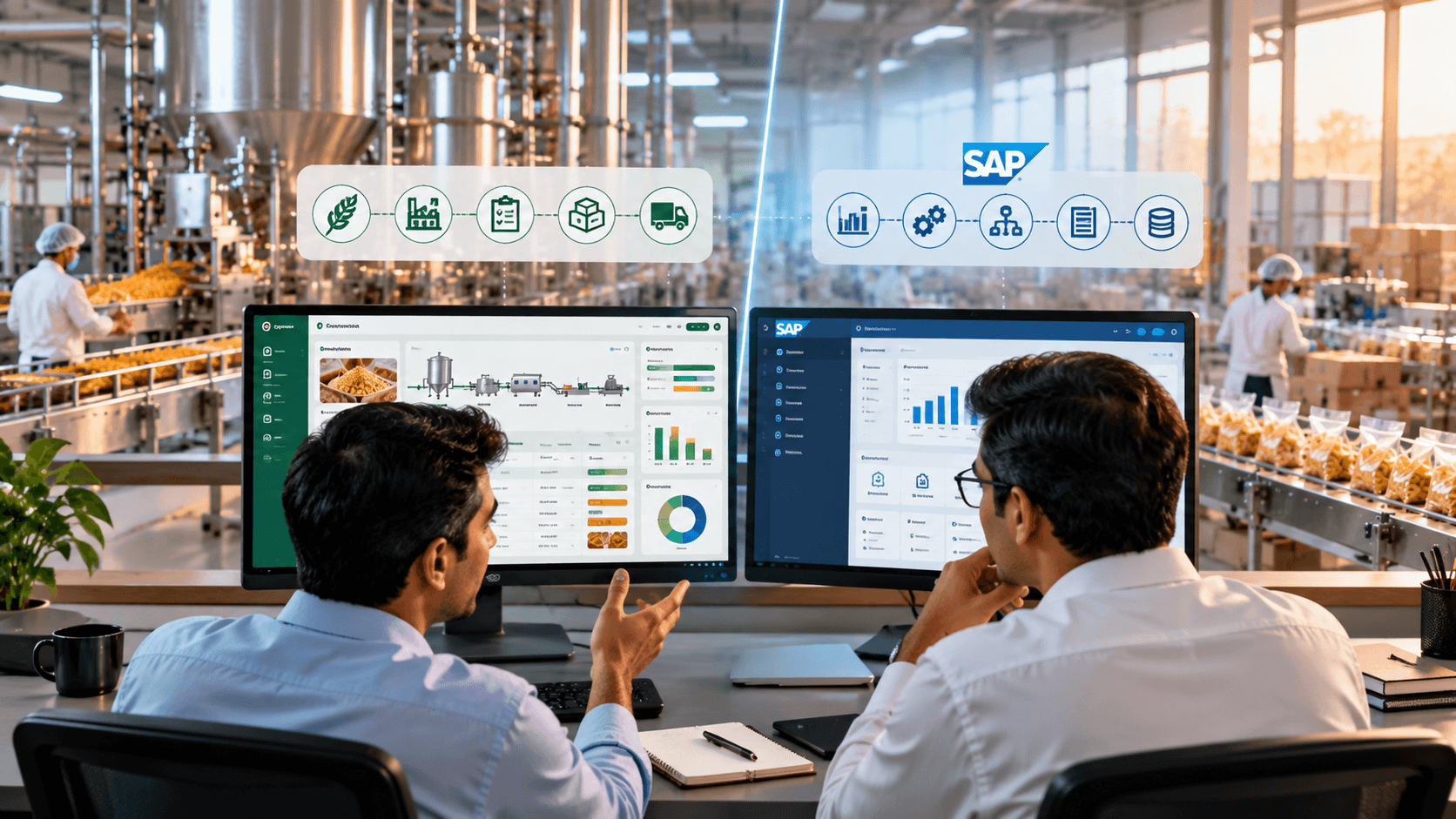
Food processing companies need more than basic inventory and accounting software. They must manage recipes, production batches, raw materials, quality checks, expiry dates, procurement, dispatch and financial reporting — often across multiple departments or manufacturing locations.
As a business grows, disconnected systems and manual processes can make these operations difficult to manage. This is when many manufacturers start comparing two options: implementing SAP or developing a custom ERP solution.
Both approaches can work well. The right choice depends on your business size, operational complexity, budget, existing systems and long-term plans.
In this guide, we compare custom ERP and SAP for food processing businesses to help you make an informed decision.
What Is SAP for Food Processing?
SAP provides enterprise software that can support manufacturing, procurement, inventory management, finance, supply chain operations and reporting. Depending on the selected SAP product and configuration, food manufacturers can use it to manage processes across their organisation.
SAP is often considered by businesses that need standardised processes across multiple departments, locations or business units.
However, implementing SAP for a food processing business may involve configuration, custom development, integration, data migration, user training and ongoing support. The actual scope and cost depend on the product, implementation partner and business requirements.
What Is a Custom ERP for Food Processing?
A custom ERP is software designed around the specific workflows of a business. Instead of adapting every process to an existing software package, the system is developed or extended to meet defined operational requirements.
For example, a dairy manufacturer may need milk procurement records, supplier-wise quality testing, fat and SNF calculations, production planning, batch tracking and dispatch management.
A packaged food manufacturer may require recipe version control, ingredient consumption, packaging material tracking, shelf-life management and batch-wise costing.
A custom ERP can bring these workflows into one connected system, provided the requirements are properly designed and implemented.
Custom ERP vs SAP: Key Differences
1. Business process flexibility
Custom ERP: The software can be designed around your existing manufacturing workflows, approval rules, product variations and reporting requirements. Changes are possible, but they still require development, testing and maintenance.
SAP: SAP provides established business processes and configuration options. Some requirements can be handled through standard functionality, while others may require extensions, integrations or changes to the operating process.
Which is better? Custom ERP may suit businesses with specialised workflows that are difficult to accommodate economically in standard software. SAP may be suitable when standardised processes and enterprise-wide consistency are priorities.
2. Implementation cost
Custom ERP: Costs depend on the number of modules, integrations, user roles, production workflows and reporting requirements. A phased implementation can help control the initial investment.
SAP: Costs depend on the selected product, licensing or subscription arrangements, implementation services, integrations, infrastructure where applicable and ongoing support.
It is not accurate to assume that every custom ERP is cheaper than SAP. A large custom system with complex integrations can become expensive, while a carefully scoped SAP implementation may be appropriate for a business’s needs.
Before deciding, compare the total cost of ownership over three to five years rather than looking only at the initial quotation.
3. Time to implement
Custom ERP: A focused first phase can concentrate on essential workflows such as inventory, production, batch tracking and quality management. Additional modules can be introduced later.
SAP: Implementation timelines depend on the selected solution, organisational complexity, data readiness, integrations, customisation and rollout approach.
Neither approach guarantees a faster launch. A realistic project plan should include requirements, data migration, testing, user training and production readiness.
4. Food processing-specific functionality
Both approaches can support food manufacturing processes, but the level of functionality depends on the chosen solution and implementation.
| Requirement | Custom ERP | SAP |
|---|---|---|
| Recipe and formulation management | Designed around specific requirements | Depends on product, configuration and extensions |
| Batch and lot tracking | Can be built around production workflows | Available capabilities depend on the selected solution |
| Expiry and FEFO management | Can be tailored to inventory rules | Depends on configuration and applicable functionality |
| Quality inspections | Can match internal quality workflows | Depends on selected quality-management capabilities |
| Production planning | Can reflect specific manufacturing processes | Supported through relevant planning and manufacturing capabilities |
| Financial reporting | Can be tailored to management needs | Can support integrated financial reporting |
| Specialised dashboards | Can be developed for defined KPIs | Standard reporting and extensions may be available |
FEFO means “First Expired, First Out”. It helps businesses prioritise stock with the earliest expiry dates, where applicable.
The important point is to verify the exact functionality through a process-based demonstration. A feature listed in a brochure does not necessarily mean it will work for your particular production process without configuration or additional development.
5. Integration with existing software
Food manufacturers often use accounting packages, weighing machines, laboratory equipment, barcode scanners, warehouse systems, e-commerce platforms and third-party logistics services.
A custom ERP can be designed around these integrations, subject to the availability of APIs, device protocols and vendor cooperation.
SAP also supports integration with other enterprise applications and external systems, but the implementation approach depends on the products and interfaces involved.
Before selecting either option, list your existing systems and confirm which integrations are technically feasible, how much they will cost and who will maintain them.
6. Scalability and long-term maintenance
A custom ERP can scale as a business expands, but scalability must be planned through suitable architecture, database design, security controls, monitoring and testing.
SAP offers established enterprise software capabilities and may be a strong fit for organisations with complex, multi-location operations. However, it still requires appropriate configuration, governance, administration and ongoing support.
For either approach, ask how the system will handle additional factories, new product lines, higher transaction volumes, more users and changing business requirements.
7. Ownership and vendor dependency
With custom ERP development, the contract should clearly define source-code ownership, intellectual property rights, hosting access, documentation, third-party licences and ongoing maintenance responsibilities.
With SAP, the organisation operates within the relevant product licensing, subscription and contractual terms.
Custom software does not automatically eliminate vendor dependency. If the original development team is the only team that understands the code, changing vendors may still be difficult. Proper documentation, code quality standards and handover procedures are essential.
Which Option Is Better for Different Food Processing Businesses?
Small and growing manufacturers
A small manufacturer may need inventory, purchasing, production records, batch tracking and accounting integration without the complexity of a large enterprise implementation.
A focused custom ERP may be worth evaluating when the workflows are specialised and the initial scope can remain manageable. An established packaged ERP may also be suitable if it already meets the business requirements.
Dairy processing companies
Dairy businesses may need milk procurement, supplier records, quality testing, fat and SNF calculations, chilling, processing, packaging and distribution workflows.
The decision should be based on whether the chosen solution can support these processes reliably, including the required calculations, equipment integrations and audit trails.
Packaged food manufacturers
Businesses producing snacks, spices, bakery products, sauces or ready-to-eat foods may prioritise recipe management, ingredient consumption, packaging materials, batch traceability, quality checks and expiry management.
Custom ERP can be useful when these workflows are distinctive. SAP may be appropriate when the company also needs broader enterprise planning, finance and supply chain capabilities.
Large manufacturers with multiple plants
Organisations operating multiple factories, warehouses and distribution centres may need standardised processes, consolidated reporting and complex access controls.
SAP deserves consideration in this situation, alongside other established enterprise ERP products and a carefully architected custom solution. The decision should account for group reporting, inter-location transactions, implementation risk and long-term operating costs.
When Should You Choose Custom ERP?
Consider custom ERP development when:
- Your manufacturing processes differ significantly from standard workflows.
- You need specialised production, costing or approval logic.
- Existing software creates repeated manual work or duplicate data entry.
- You require specific integrations with equipment or business applications.
- You want to implement essential modules in phases.
- You need management dashboards designed around your business KPIs.
- You can allocate resources for software maintenance, security and future development.
Custom ERP is not automatically the right choice just because a business wants flexibility. Requirements should be documented, prioritised and compared against existing software before development begins.
When Should You Choose SAP?
Consider SAP when:
- Your organisation needs broad enterprise functionality across departments.
- You want to standardise processes across several business units or locations.
- Your business has complex finance, procurement and supply chain requirements.
- You need integration with an existing SAP environment.
- Your team can support the implementation, change management and ongoing operating costs.
- Standard functionality can satisfy most requirements without excessive customisation.
The selected SAP product matters. SAP offers different products for different business needs, so comparisons should be made against a specific product and implementation scope rather than treating SAP as one uniform solution.
What About a Hybrid Approach?
The choice does not always have to be custom ERP or SAP.
A manufacturer may use SAP for core finance and enterprise processes while connecting it to specialised manufacturing applications. Another business may use a custom production and traceability system integrated with an established accounting package.
A hybrid approach can be practical when an existing system already performs certain functions well. However, integrations must be reliable, data ownership must be clear, and teams need a consistent view of inventory, production and financial information.
Avoid creating multiple systems that maintain conflicting versions of the same records.
How Much Does Custom ERP vs SAP Cost?
There is no reliable universal price for either option.
The cost of custom ERP depends on factors such as:
- Number of modules and manufacturing locations.
- Complexity of recipes, production and quality workflows.
- Integrations with equipment and existing software.
- Data migration and historical records.
- Reporting, security and user permissions.
- Testing, training, hosting and ongoing maintenance.
SAP costs depend on the selected product, licensing or subscription terms, implementation partner, configuration, extensions, integrations and support arrangements.
To compare proposals fairly, request a breakdown covering implementation, recurring fees, third-party costs, change requests, maintenance and future expansion.
A Practical Checklist Before Making Your Decision
Before committing to either approach, ask your team and shortlisted vendors these questions:
- Can the system manage our actual production workflow from raw material receipt to finished-goods dispatch?
- How are recipes, formulation changes and ingredient consumption recorded?
- Can we trace a finished batch back to its raw materials and suppliers?
- How are quality checks, rejected materials and corrective actions handled?
- Does the system support expiry dates and FEFO stock allocation where required?
- Can it integrate with our accounting software, equipment and existing applications?
- What happens when we introduce a new product, factory or production line?
- What are the complete implementation and recurring costs?
- Who owns the data, code and documentation, and who will maintain the system?
- Can the vendor demonstrate our real workflows using realistic sample data?
A structured evaluation is more valuable than selecting software based only on brand recognition, a feature list or the lowest quotation.
How Ozrit Helps Food Processing Companies
Ozrit develops business software around defined operational requirements. For food processing companies, the scope of a custom ERP can include production planning, recipe and formulation management, procurement, inventory, quality workflows, batch traceability, finance integrations and management reporting.
The exact modules depend on the manufacturer’s products, processes, existing applications and implementation priorities.
Our approach starts with understanding the business workflow, identifying gaps in existing systems and defining a practical implementation scope. Modules can then be prioritised according to business needs, with integration, testing, documentation and user training included in the project plan as agreed.
If you are evaluating SAP, an existing ERP or a custom-built system, we can help assess your requirements and explore whether a custom ERP approach is appropriate.
Explore our Food Processing ERP Development Services to discuss your manufacturing workflows and software requirements.
Frequently Asked Questions
Is custom ERP better than SAP for food processing?
Not in every situation. Custom ERP may be suitable for specialised workflows and focused implementation, while SAP may suit organisations that need broad enterprise functionality and standardised processes. The right choice depends on requirements, cost and complexity.
Can a custom ERP handle batch traceability and expiry management?
Yes, these capabilities can be developed as part of a custom ERP. The implementation should define batch identifiers, material relationships, expiry rules, stock allocation, audit trails and the ability to trace affected products.
Can custom ERP integrate with SAP?
Yes, integration may be possible through supported APIs, middleware, data interfaces or other approved integration methods. Feasibility depends on the SAP product, available interfaces, security requirements and the external system.
Is SAP suitable for small food processing companies?
It can be, depending on the selected product and business requirements. Smaller manufacturers should evaluate the total cost, implementation effort and availability of simpler alternatives before deciding.
How long does custom food processing ERP development take?
The timeline depends on the scope, integrations, data readiness and testing requirements. A focused first phase may be delivered sooner than a full multi-factory ERP implementation, but the timeline should be established after requirements analysis.
Can an ERP guarantee FSSAI compliance?
No software system can guarantee compliance on its own. ERP can help maintain relevant records, support traceability and organise quality workflows, but compliance also depends on applicable requirements, correct system configuration, operational practices and appropriate human oversight.
Final Thoughts
Choosing between custom ERP and SAP is a business decision, not just a technology decision.
Start by documenting your production processes, identifying gaps in existing systems and calculating the total cost of ownership. Then evaluate each solution against the same requirements and request demonstrations of your actual workflows.
The best ERP is the one your business can implement successfully, use consistently and maintain as operations grow.